Last updated 2026-08-19
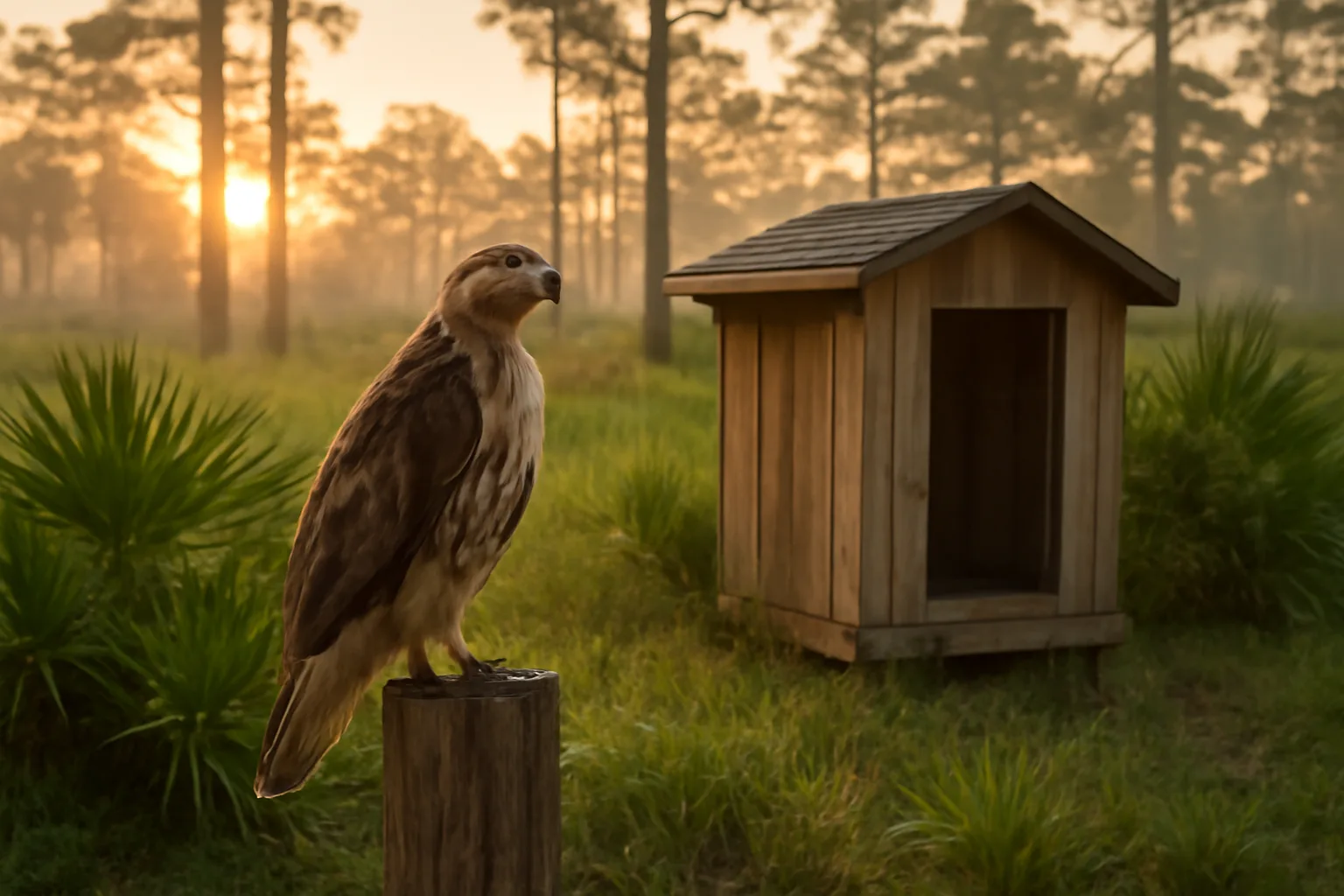
TL;DR
To start falconry in Florida you get an FWC falconry permit that meets 50 CFR 21.82. That means an 80 percent exam, a sponsor if you are an apprentice, inspected housing, and then a bird. Apprentice status lasts at least 2 years. A Florida hunting license is separate paper if you hunt quarry. Confirm current FWC fees and forms before you spend a dime on lumber or a hawk.
Do you need a license for falconry in Florida?
Yes. You need a Florida Fish and Wildlife Conservation Commission falconry permit that meets the federal falconry standards in 50 CFR 21.82.[1][2] Taking or keeping a raptor for falconry without that permit breaks the Migratory Bird Treaty Act. 16 U.S.C. 703 states that "it shall be unlawful at any time, by any means or in any manner, to pursue, hunt, take, capture, kill" migratory birds except as permitted by regulation.[5]
That is the core rule. No permit, no bird.
Florida's own rule is 68A-9.005, titled Falconry.[2] FWC gives the exam, inspects housing, and issues the permit that carries state and federal weight.[3] You usually do not mail a second application to a U.S. Fish and Wildlife Service desk for a separate falconry card. Almost every hawk, falcon, and owl you would fly is a migratory bird under 50 CFR 10.13, so the federal layer is not optional.[9]
A Florida hunting license is different paper. Buy one if you hunt legal quarry with the bird.[4][7]
Ignore the myth that a captive-bred hawk is off the books. Captive-bred raptors still fall under migratory bird rules. Bands, reports, and a live permit still apply.[1][6]
I would not buy a bird first. Paper first. Housing next. Bird last. Reverse that order and you can end up with an animal you cannot legally keep.
Already hold a permit from another state? You still contact FWC before a bird enters Florida. Reciprocity is not a handshake. Compare the move-in steps people use in how to start falconry in Alabama if you are relocating along the Gulf. Confirm Florida's current transfer checklist with the commission. No article should promise you an approval date.
What are the actual first steps to start falconry in Florida?
Start with people, not gear.
Find a General or Master falconer in Florida who will sponsor you. Federal rules require a sponsor at the apprentice class.[1] FWC will not treat an internet stranger in another time zone as your sponsor. Ask working Florida falconers, NAFA contacts, and hunt clubs.[8]
Read 68A-9.005 and 50 CFR 21.82 cover to cover before you sit the exam.[1][2] Then schedule the test with FWC. Federal falconry rules set the passing score at 80 percent (50 CFR 21.82).[1]
Build or arrange housing that can pass inspection. FWC inspects before you get the permit.[2][3] Do not trap or buy a raptor until the permit is in hand.
File the application FWC posts on its falconry page. Confirm the current form and fee there. Fees change. I will not invent one.[3]
After the permit, you may acquire a bird by legal wild take (if your class and the season allow it) or by transfer from another permittee. Both go on a federal 3-186A acquisition report.[6]
That is the path. People try to skip the sponsor and stall for a year instead. I would not sit the exam until a local sponsor has said yes out loud.
Want a side-by-side of how a nearby state lines up the same federal skeleton? The Alabama falconry license writeup is a useful contrast.
How much does falconry cost in Florida?
Nobody publishes a clean first-year total for falconry in Florida. The honest picture is a stack of line items, some fixed by statute and some that balloon based on how you build a mews.
Florida Statute 379.354 sets the resident annual hunting license fee at $17.[4] That is not the falconry permit. Confirm the current falconry permit fee on the FWC application. I will not guess it.
Housing is the real bill. A simple backyard mews can run a few hundred dollars in used lumber if you already have a fence and shade. A new, inspected building with a weathering yard can climb into the low thousands. I have watched people overbuild a mews like a guest cottage. That is a waste of money at apprentice.
Used gear is fine. A glove, jesses, leash, swivel, bath pan, and a gram scale are the federal basics.[1] Buy a decent scale. Cheap kitchen scales drift, and a drifting scale means you starve or stuff a bird.
Food is a monthly cost for the life of the bird. Quail, rats, and day-old chicks add up. Budget for it before you trap.
Telemetry is optional on day one. I would not drop a large sum on a GPS rig before I have flown a passage red-tail for a season. A used radio setup is enough if your sponsor says you need one.
Want one packet that walks exam topics, sponsor search, and a mews checklist? FalconryPath sells a $149 one-time State Exam + Sponsor + Mews Kit at /start. Skip it if you already have a sponsor and a copy of 68A-9.005. This page still works without it.
First-year cash, in my view, often lands in the low thousands once lumber, food, and a hunting license sit together. It can be less if you DIY and borrow. It can be much more if you buy new everything. Confirm every government fee with FWC before you write a check.[3]
For another state's cost stack, see falconry cost in Alabama.
How long does falconry take in Florida?
Plan on years, not a season.
The apprentice class lasts at least 2 years under 50 CFR 21.82.[1] Those 2 years start after you are permitted, not after you pass the exam. Sit around without a bird and the clock may not mean what you think. Confirm with FWC how they count experience.
Getting to the exam date is the part nobody can calendar for you. Finding a sponsor is the usual delay. Some people land one in a month. Some hunt for a year.
Inspection scheduling runs on FWC's calendar, not yours. Confirm current wait practice with the regional office. I will not invent a processing time.[3]
After 2 years as an apprentice, you can ask to move to General if your sponsor supports it and you meet 68A-9.005.[2] General to Master takes another 5 years at General under the federal standard.[1]
So the honest answer runs like this. A couple of months to a year to get permitted if a sponsor and a mews are ready. Then 2 years of apprentice work before General. Then 5 more if you care about Master. Plenty of good falconers stay General forever. Master is status, not a hunting upgrade you need.
Do not expect FWC to rush an inspection because hunting season opened. Nobody has good public data on how many Florida apprentices finish those 2 years. The closest hard number is the federal minimum itself.
What exam do you take for a Florida falconry permit?
You take a written falconry examination that FWC administers.[3] Federal falconry rules set the passing score at 80 percent (50 CFR 21.82).[1] The rule says you must "correctly answer at least 80 percent of the questions on an examination administered by the State, tribe, or territory."[1]
The test covers law, raptor biology, health, housing, and hunting practice. It is not trivia about famous falconers.
Study the federal rule and 68A-9.005 until you can explain possession limits and facility rules without notes.[1][2] NAFA's getting-started materials are a decent outline of what working falconers expect you to know.[8]
Confirm with FWC how to schedule, where you sit, and what ID you bring. I will not invent a sitting calendar.
Fail it and you retake. Confirm the wait rule with the board. Do not pay a tutor who promises leaked questions. That is how you get a reputation before you own a bird.
Passing does not issue the permit. You still need a sponsor if you are an apprentice, passing facilities, and a complete application.[2] The exam is a gate, not the license.
Do you need a sponsor to start falconry in Florida?
Yes, if you enter as an apprentice. 50 CFR 21.82 requires a sponsor who is a General or Master falconer.[1] Florida applies that through 68A-9.005.[2]
A sponsor is a person who will actually stand next to you while you trap, man, and hunt a bird. A signature on a form is not enough. If they live four hours away and never hunt, find someone else.
I would ask to go in the field with them before I commit. Watch how they handle a bird on a kill. If they dodge that, walk.
Out-of-state sponsors are a bad fit for a Florida apprentice. Weather, quarry, and FWC contacts are all local.
Parents can hold paperwork if you are a minor under federal rules, but the sponsor still has to be a permitted General or Master.[1] Confirm Florida's minimum age in 68A-9.005. The federal floor is 12 years. Some states set a higher number. I will not guess Florida's off an old forum post. Open the current rule on flrules.org.[2]
Sponsor letters matter again when you apply for General. Keep that relationship honest for 2 years. A sponsor who disappears after the application is a problem you created by picking poorly.
What housing and equipment does Florida require before you get a bird?
FWC inspects your facilities before you get a permit.[2][3] Federal rules require housing that protects the bird from predators, weather, and escape, plus basic equipment: jesses, a leash and swivel, a bath container, and a reliable scale.[1]
Indoor housing is the mews. Outdoor space is the weathering area. Dimensions and materials have to satisfy both 50 CFR 21.82 and whatever 68A-9.005 adds.[1][2] Read both. Then build.
I would not pour a fancy slab until a sponsor has walked the yard. People build to a photo and fail inspection on perch design or predator-proofing.
A bath pan and a T-perch are cheap. The expensive mistake is a mews that cooks a bird in Florida summer sun with no shade or airflow. Design for heat.
HOA covenants and county zoning are not FWC's problem. An inspector can love your mews and your association can still make you tear it down. Ask zoning and the landlord first.
Renters have a hard time. You need written permission to put up a structure and keep a hawk. If the lease is silent, assume no.
Do not keep a falconry raptor in a parrot cage in a spare bedroom and hope. That fails inspection. It is also a bad way to keep a hawk in this climate.
What raptors can a Florida apprentice keep?
Federal falconry rules limit an apprentice to 1 raptor (50 CFR 21.82).[1] Eagles are off the table at apprentice. Hybrid and captive-bred rules sit in the same federal section. Confirm the exact apprentice species list in 68A-9.005 before you trap or write a check for a bird.[2]
I will not invent Florida's current apprentice list. States often limit wild-caught apprentice birds to species like the American kestrel or red-tailed hawk. Florida may match that or differ. Open the rule.
Wild take, if allowed for your class, follows federal and FWC seasons and reporting.[1][6] You do not pull a nestling off a power pole because a video told you to.
Captive-bred birds still need a legal transfer onto your permit and a 3-186A report.[6]
Harris's hawks are common in warm states and often captive-bred. Whether an apprentice in Florida may start on one is a 68A-9.005 question, not a forum question. Confirm it.
Imprint birds are a poor first bird for most people. I would start on a passage wild hawk if the rule allows it and a sponsor will trap with me.
Do you also need a Florida hunting license to fly a hawk?
Yes, if you hunt. Falconry is a method of take. The bird is no free pass around game laws.[7]
Florida Statute 379.354 sets the resident annual hunting license fee at $17.[4] Nonresident prices run higher in the same statute. Confirm what you actually owe on the FWC license site, because other permits (management area access, and so on) stack on top depending on how you hunt.[4][7] Waterfowl still needs a federal migratory bird hunting stamp under 16 U.S.C. 718a if that is your quarry.[12]
Seasons and bag limits still apply. A hawk can catch a rabbit in the wrong month and you can still be in the wrong. Read the current FWC hunting regulations before you slip the bird.[7]
Landowner permission is required on private land. Public land has its own access rules. Falconry does not create a right to walk a Wildlife Management Area without the right permit.
If you only fly at unprotected species, ask FWC how they treat that under your permit. Do not take a guess from a comment thread.
You can hold a falconry permit and still owe the hunting license each year. They do not merge.
Can you practice falconry if you rent or live in a Florida city?
You can try. Plenty of Florida falconers live in towns, not on 40 acres. The limiting factor is a legal mews that passes FWC inspection and does not violate local code.[2][3]
Apartments almost never work. Balconies fail predator-proofing and escape tests. Neighbors will call animal control. I would not start this path on a 12-month lease with a no-pets clause.
Incorporated cities may restrict livestock or wild animals in ways that catch a hawk. Read the ordinance. Call the city before you buy lumber.
If you hunt, you still need access to land. A suburban mews with no hunting permission is how people end up with an overweight display bird and call it falconry. That is a waste.
Compare land pressure in denser states in the California falconry license guide if that problem is familiar. Florida still has rural counties where a red-tail and a rabbit field are a short drive. Use that if you can.
Talk to the landlord in writing. A verbal "sure, whatever" disappears the moment a neighbor complains.
What changes when you move from apprentice to general in Florida?
After at least 2 years as an apprentice, you can apply for General if you meet 50 CFR 21.82 and 68A-9.005.[1][2] Your sponsor documents that you are ready. FWC may inspect again. Confirm the current upgrade packet with the commission.
Federal possession limits (standard counts) look like this:
| Class | Minimum time in prior class | Raptors you may possess | Sponsor required |
|---|---|---|---|
| Apprentice | Entry class | 1 | Yes |
| General | 2 years as apprentice | 3 | No |
| Master | 5 years as general | 5 | No |
Those counts come from 50 CFR 21.82.[1] Florida can be stricter. Check 68A-9.005 before you plan a second bird.[2]
General is when most people add a different hunting style. It is also when you can sponsor someone else, once you meet the federal experience mark for sponsors.
Master is five more years. I would not chase Master for a patch. Chase flying days.
Move later and other states will ask for your Florida class dates. Keep copies. The Arizona falconry license path is another 50 CFR 21.82 state with its own overlay, same as how to start falconry in Arkansas.
What paperwork do you file after you get a bird in Florida?
The day you acquire a bird, you report it. U.S. Fish and Wildlife Service uses Form 3-186A (Migratory Bird Acquisition and Disposition Report) for take, transfer, loss, and death.[6] Deadlines are short. Read the form. Late paperwork is how clean falconers get messy files.
Bands stay on. If a band is lost, follow the replacement steps in the federal rule and notify FWC.[1][2]
You keep records. If an officer asks, you produce the permit, the 3-186A history, and a healthy bird in legal housing.
Release, transfer, or death all get reported. You do not let a bird go behind the house and stay quiet.
Annual or periodic reports, if FWC requires them, run on the commission's calendar. Confirm current reporting on the falconry page.[3]
If the bird escapes, call your sponsor and follow the lost-bird steps they use. Telemetry helps. So does telling neighboring falconers.
FalconryPath is an independent publisher, not a law firm and not a service company. Nothing here is legal advice. For a checklist-style kit on the exam, sponsor search, and mews planning, see /start. Confirm every fee, form, and inspection step with FWC before you act.[3]
Want another state's paper path after this? How to start falconry in Arizona is a clean comparison, as is how to start falconry in California.
Frequently asked questions
Do you need a license for falconry in Florida?
Yes. You need a Florida Fish and Wildlife Conservation Commission falconry permit that meets 50 CFR 21.82 and Florida rule 68A-9.005. Keeping a hawk or falcon for falconry without it violates the Migratory Bird Treaty Act. A hunting license is separate paper if you hunt quarry. Confirm the current application with FWC.
How much does falconry cost in Florida?
There is no official first-year total. The resident annual hunting license is $17 in Florida Statute 379.354. The falconry permit fee is whatever FWC posts on the current application, so confirm it. Housing, food, and gear usually dwarf the license line. DIY mews keep costs down. Buying all-new telemetry on day one is a common waste.
How long does falconry take in Florida?
The apprentice class lasts at least 2 years under 50 CFR 21.82, and that clock runs after you are permitted. Finding a sponsor and passing inspection can take months with no published FWC timeline. General status needs those 2 years plus a sponsor letter. Master needs 5 more years at General. Confirm how FWC counts experience.
How old do you have to be to start falconry in Florida?
Federal rules set a floor of 12 years for an apprentice, with a parent or guardian involved if you are under 18. Florida can set a higher minimum in 68A-9.005. Do not rely on an old forum number. Read the current rule on flrules.org and confirm with FWC before you plan around a birthday.
Can a Florida apprentice trap a wild hawk?
Only after the FWC falconry permit is issued, and only if 68A-9.005 and the federal take rules allow that species and age class. Seasons and reporting still apply. You file a 3-186A when you acquire the bird. Trap with your sponsor. Confirm the current take window with FWC. Do not take a nestling off infrastructure.
Is a Harris's hawk legal for a Florida apprentice?
Maybe, if 68A-9.005 allows that species at apprentice, which often depends on captive-bred versus wild status. Federal rules still cap an apprentice at 1 raptor and bar eagles. Do not buy a Harris's hawk off a breeder until you read the current Florida species list and your permit class. Confirm it with FWC.
Does Florida require a federal falconry permit on top of the state permit?
In the usual case, no second federal falconry card. FWC issues the permit that carries both state and federal weight under 50 CFR 21.82. You still follow federal reporting on Form 3-186A. If you already hold another state's permit, you still check in with FWC before a bird enters Florida. Reciprocity is not automatic.
Can you keep a falconry bird in a Florida apartment?
Almost never. FWC inspects facilities against 50 CFR 21.82 and 68A-9.005. A balcony or spare bedroom fails predator-proofing, weather, and escape tests. Leases and city animal rules often block it anyway. You need written landlord permission and a real mews. I would not start falconry on a short lease.
What score do you need on the Florida falconry exam?
Federal falconry rules set the passing score at 80 percent (50 CFR 21.82). FWC administers the test. Passing the exam is not the permit. You still need a sponsor at apprentice, inspected housing, and a complete FWC application. Confirm scheduling and retake rules with the commission. Study the actual rules, not leaked question sets.
Do you need landowner permission to hunt with a hawk in Florida?
Yes on private land. Falconry does not create an access right. On public land you still need the hunting license, any management-area permit, and you must follow posted rules and seasons. Read the current FWC hunting regulations before you fly. A legal bird on illegal ground is still a problem.
How do you transfer a falconry permit if you move to Florida?
Contact FWC before the bird crosses the state line. Read 68A-9.005 for incoming permittees. Reciprocity is not a handshake, and class standing in another state does not auto-print a Florida card. Facilities in Florida still get inspected. Confirm the current transfer packet and fee with the commission. Keep copies of your old 3-186A history.
What happens if your Florida falconry facilities fail inspection?
You do not get the permit, and you still cannot acquire a bird. Fix the defects the inspector named and ask FWC how to reinspect. Confirm that process with the board. I would bring a sponsor to the rebuild so you do not fail twice on perch design or summer shade. Do not house a raptor while you wait.
Sources
- eCFR, 50 CFR 21.82 Falconry standards and falconry permitting: Federal falconry standards require an 80 percent exam score, a sponsor at apprentice, class timelines of 2 years then 5 years, possession limits of 1/3/5 raptors, facility and equipment rules, and reporting.
- Florida Administrative Code Rule 68A-9.005 Falconry: Florida implements falconry permitting, facilities, classes, and related restrictions through FWC rule 68A-9.005.
- Florida Statute 379.354 Recreational licenses, permits, and authorization numbers: Florida Statute 379.354 sets the resident annual hunting license fee at $17 and lists other recreational license prices.
- 16 U.S.C. § 703, Migratory Bird Treaty Act taking prohibition: The Migratory Bird Treaty Act makes it unlawful to pursue, hunt, take, capture, or kill migratory birds except as permitted by regulation.
- Florida Fish and Wildlife Conservation Commission, Hunting regulations: Hunting with a raptor still follows FWC seasons, methods, bag limits, and area rules.
- North American Falconers Association, Getting Started: NAFA publishes beginner guidance on finding mentors and learning falconry practice before permitting.
- eCFR, 50 CFR 10.13 List of Migratory Birds: Hawks, falcons, and owls used in falconry are listed migratory birds under 50 CFR 10.13.
- 16 U.S.C. § 704, Migratory Bird Treaty Act determinations as to when and how migratory birds may be taken: Interior may adopt regulations that authorize otherwise prohibited take of migratory birds, which is the statutory basis for falconry permits.
- 16 U.S.C. § 718a, Migratory bird hunting and conservation stamp: Hunting migratory waterfowl requires a federal migratory bird hunting and conservation stamp in addition to state licenses.