Last updated 2026-08-17
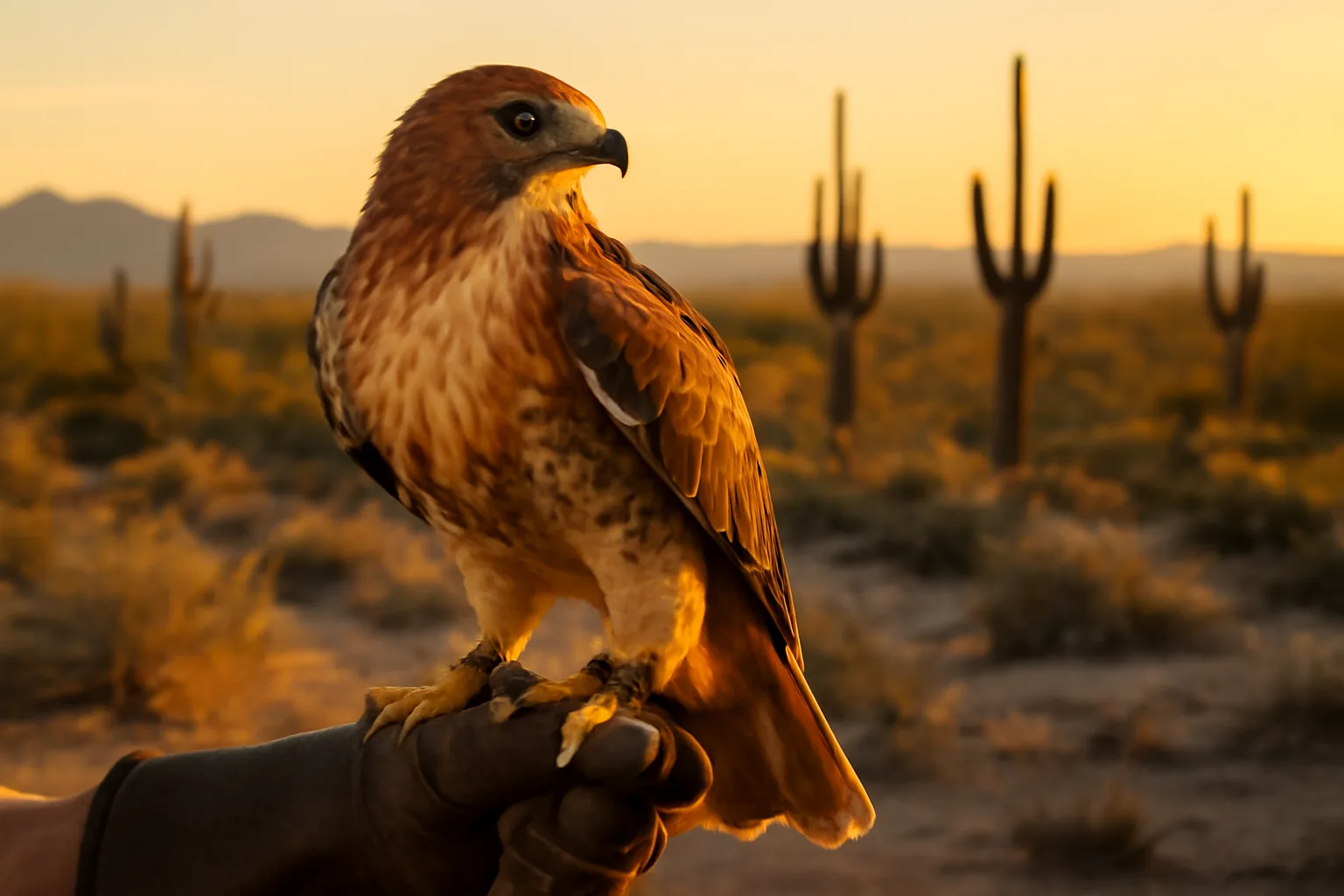
TL;DR
Starting falconry in Arizona means passing the federal/state falconry exam, finding an Arizona-licensed General or Master falconer to sponsor you, building a compliant mews, and holding both a U.S. Fish and Wildlife Service permit and an Arizona Game and Fish Department falconry license. The apprentice period runs a minimum of two years. Exam, license, and facility inspection fees are separate costs; confirm current amounts with AZGFD before applying.
Do you need a license for falconry in Arizona?
Yes. Every practicing falconer in Arizona needs two permits running simultaneously: a state falconry license from the Arizona Game and Fish Department (AZGFD) and a federal falconry permit issued under the Migratory Bird Treaty Act by the U.S. Fish and Wildlife Service (USFWS). Neither alone is enough.
The federal side exists because all raptors used in falconry are protected migratory birds under federal law [1]. USFWS regulations at 50 CFR Part 21 set the national framework: three license classes (Apprentice, General, Master), minimum age requirements, possession limits, and bird-acquisition rules [2]. Arizona then layers its own requirements on top through the Arizona Revised Statutes and AZGFD regulations.
Arizona adopted the 2008 federal framework agreement, which means AZGFD administers falconry within its borders while USFWS keeps oversight of the migratory bird permit. You apply for both through the same AZGFD licensing process. One application, one fee cycle, but two legal documents come out the other end.
No license means you cannot legally possess a raptor for falconry purposes, period. That includes borrowed birds and birds held during training. Law enforcement treats unlicensed possession of a protected raptor seriously, with federal penalties under the Migratory Bird Treaty Act reaching up to $15,000 per violation [3].
What are the three falconry license classes in Arizona?
Arizona uses the federal three-class system with no changes to the class definitions.
Apprentice is where everyone starts. You must be at least 14 years old [2]. You need a licensed General or Master falconer as your sponsor. You can possess one bird, either an American kestrel or a red-tailed hawk. You cannot trap passage raptors other than what the regulations allow for those two species. The apprentice period is a minimum of two years.
General requires at least two years as an Apprentice and a recommendation from your sponsor. You can possess up to three raptors, with access to a broader list of species. No minimum age beyond what it takes to reach two years of Apprenticeship.
Master requires at least five years at the General level. You can possess up to five raptors, including some species restricted from lower classes, and you can sponsor Apprentices yourself.
Advancement isn't automatic at the time threshold. You apply for it, and AZGFD reviews whether your facility, records, and sponsor endorsement support the upgrade. Don't assume the two-year clock alone moves you to General.
How does the Arizona falconry exam work?
You cannot apply for a license until you pass the written exam. AZGFD administers a 100-question test covering raptor biology, husbandry, equipment, federal and state regulations, and field practices [4]. The passing score is 80 percent, meaning you need at least 80 correct answers.
The exam is offered at AZGFD regional offices or by appointment. Scheduling and location options change, so contact AZGFD directly to find current testing sites and calendar dates. There is an exam fee; confirm the current amount with AZGFD because published fee schedules get updated.
Study material matters here. USFWS publishes falconry regulations and legal references [2], and the North American Falconers Association (NAFA) sells a study guide that closely mirrors exam content [7]. Most people who fail do so on the regulatory questions, not the biology. Read 50 CFR Part 21, Subpart C before you sit.
You can take the exam before you have a sponsor lined up. Some people prefer it that way because passing the exam makes you a more credible candidate when approaching potential sponsors. Others find a sponsor first who can guide their study. Either sequence works.
How do you find a falconry sponsor in Arizona?
Your sponsor must hold an Arizona General or Master falconry license and must actively agree to take you on. AZGFD requires the sponsor's signature on your application. No signature, no license.
The Arizona Falconers Association is the best starting point [5]. Their membership includes General and Master falconers across the state, and they hold field meets where you can meet people who actually fly birds. Attending a meet before you ask anyone to sponsor you is the right move. Show up, watch, help carry equipment, ask questions. Sponsors take on real legal and mentoring responsibility; nobody signs for a stranger who cold-emailed them.
NAFA also maintains a regional contact list [7]. Don't overlook raptor rehabilitation centers, which often have volunteers who are licensed falconers and can point you toward active sponsors in your area.
Arizona's geography creates some clustering. The Phoenix metro, Tucson area, and Flagstaff each have active falconers. Rural counties can be thin. If you're in a rural area, expect to drive to meets and be willing to work with a sponsor who isn't local to you, which the regulations allow as long as your sponsor can inspect your facility and assess your progress.
One honest note: finding a sponsor is the hardest single step for most beginners. The exam you can study for on your own schedule. Sponsor relationships depend on other people's willingness and time. Start this process early.
What facilities does Arizona require before you can get a bird?
Before AZGFD issues your license and before you acquire a bird, your mews (the housing structure for your raptor) must pass an inspection by an AZGFD officer [4]. This inspection confirms the facility meets minimum federal and state standards.
Federal regulations at 50 CFR 21.29 specify what a compliant facility needs [2]. The perch must be appropriate for the species. The structure must protect the bird from predators and weather. There must be a double-door entry system (a small antechamber or separate door arrangement) so the bird cannot escape when you enter. There must be a tethering or free-loft arrangement that prevents injury. Fresh water must be accessible.
Arizona's desert climate adds practical pressure beyond the regulatory floor. Shade and ventilation are not optional luxuries here; birds in direct Arizona summer sun overheat fast. A compliant mews in Phoenix needs to address heat in ways a compliant mews in Flagstaff does not. Your sponsor can review your facility plans before you build, which saves you a failed inspection.
The inspection appointment is typically scheduled through your AZGFD regional office. The officer checks the mews against the regulatory checklist and signs off if it passes. If it fails, you address the deficiencies and schedule a re-inspection. There is no shortcut around this step.
Equipment like jesses, bells, a leash, a perch, a scale, and a bath pan must be on hand before you acquire a bird. Some of this overlaps with the mews requirements; an officer may ask to see basic equipment during the facility inspection.
How much does falconry cost in Arizona?
There is no single number here because costs split across several categories that don't all hit at once. Here is an honest breakdown by category.
Exam fee: AZGFD charges a fee to sit the written exam. Confirm the current figure directly with AZGFD because fee schedules get revised.
License fee: The state falconry license carries an annual or multi-year fee. AZGFD's published fee schedule is the authoritative source; the number has changed over time [4].
Federal permit: USFWS charges a separate fee for the federal falconry permit. Federal migratory bird permit fees are set under 50 CFR Part 13, and falconry permits have historically run on five-year terms with fees around $100 for non-commercial use, but confirm current USFWS fee schedules because they adjust [8].
Mews construction: This is the biggest variable. A basic but compliant mews can be built for a few hundred dollars using lumber, hardware cloth, and basic framing. An elaborate structure can cost several thousand. Most apprentices build something modest and functional.
Equipment: A complete first-year equipment set (jesses, anklets, swivel, leash, bells, hood, lure, glove, scale, bath pan, transport box) runs roughly $200 to $500 depending on whether you buy new or source from experienced falconers. Hoods and jesses for a kestrel cost less than for a red-tail.
Bird acquisition: Apprentices in Arizona trap wild passage birds rather than buying captive-bred birds as a first-year option. The trapping itself is free but requires a federal banding authorization and the right gear. Confirm current rules with AZGFD, as captive-bred bird rules for Apprentices have varied by state.
Ongoing costs: Feed (quail, mice, day-old chicks), veterinary care for a new passage bird, and any permit renewal fees recur annually. Budget $300 to $600 per year for feed and routine vet care at the Apprentice level, though this varies a lot based on your bird's health and hunting activity.
FalconryPath offers a bundled prep kit covering the exam and sponsor search process at falconrypath.com/start, which some new applicants find useful for structuring the early steps.
| Cost category | Typical range | Timing |
|---|---|---|
| State exam fee | Confirm with AZGFD | Before application |
| State license fee | Confirm with AZGFD | At application |
| Federal permit fee | ~$100 / 5 years (confirm) | At application |
| Mews construction | $300 to $3,000+ | Before bird acquisition |
| First-year equipment | $200 to $500 | Before bird acquisition |
| Annual feed and vet | $300 to $600 estimate | Ongoing |
How long does falconry take in Arizona from start to first bird?
The realistic timeline from "I want to do this" to a legal bird on your fist is somewhere between six months and two years for most people. The wide range comes entirely from the sponsor search and facility readiness steps, not the paperwork.
Here is a rough sequence. Studying for and passing the exam takes most people one to three months of serious preparation. Finding a sponsor can take anywhere from a few weeks (if you're plugged into the Arizona falconry community) to over a year (if you're starting cold in a rural area). Building your mews and gathering equipment typically takes one to three months after you have a sponsor giving you feedback on the design.
Once you have a passing exam score, a signed sponsor, a completed application, and a passed facility inspection, AZGFD processes your application. Processing times vary; do not book your trapping trip until your license is in hand.
The two-year Apprentice period starts from the date your license is issued, not from when you first started studying. You cannot rush the clock.
The federal falconry permit runs on a five-year term and is renewed separately. Keep both the state and federal renewals on your calendar; letting either lapse means you're technically unlicensed even if the other document is current.
Total elapsed time from first serious study to first legal bird in Arizona: plan for a full year to be safe. Some people do it faster. Some take longer.
What birds can Arizona Apprentices trap or possess?
Under federal regulations at 50 CFR 21.29, Apprentice falconers are limited to two species: the American kestrel and the red-tailed hawk [2]. Arizona follows this federal limit without expanding it.
Most Arizona Apprentices start with a passage red-tailed hawk. Red-tails are abundant in the state, trap relatively easily with a bal-chatri or other standard trap, train well for game hawking, and their larger size makes handling and health assessment more forgiving for beginners. Kestrels are an option but their small size makes husbandry less forgiving and their quarry list is narrower.
"Passage" means a bird in its first year of life, hatched the previous season and not yet a full adult. Passage birds are preferable for falconry because they haven't fully established wild hunting patterns and they condition and train more readily than adult birds. Trapping must occur during the legal trapping season; confirm current season dates with AZGFD.
You can possess one bird as an Apprentice. If your bird dies or is released, you may acquire a replacement, but you cannot hold two birds simultaneously at this class level.
Arizona's raptor population includes Harris's hawks, prairie falcons, and Cooper's hawks, which you'll see in the field. You cannot legally trap or possess those species as an Apprentice regardless of how abundant they are locally.
What records does Arizona require you to keep?
Recordkeeping is a real legal obligation, not a suggestion. Federal regulations require you to maintain a register of all raptors you possess, acquire, transfer, or lose [2]. Arizona follows the federal framework.
You need to record each bird's species, age class, sex (if determinable), and acquisition method. If you trap a wild bird, you record the trap date, location, band number if banded by USFWS, and any pertinent condition notes. If a bird dies, you record the date and circumstances. If you transfer a bird to another falconer or to a wildlife rehabilitator, you record that too.
USFWS has a specific form for acquisition and disposition of birds. Your sponsor should show you what a properly maintained raptor register looks like; it's one of the core things a good sponsor teaches during the Apprentice period.
AZGFD can inspect your facility and records at any reasonable time. Keep everything current. Inspectors do look at record dates; a bird you acquired three months ago that appears in the register for the first time the week of an inspection is a problem.
One practical note: a simple notebook works legally, but many falconers keep a digital register with photographs of each bird for documentation. Either format is fine as long as the required data fields are present.
Who regulates falconry in Arizona and where do you apply?
AZGFD is the primary state authority. The Arizona Revised Statutes Title 17 covers wildlife licensing [9], and AZGFD's Commission Rules (Arizona Administrative Code Title 12, Chapter 4) contain the specific falconry provisions [6]. Applications, fee payments, facility inspection requests, and license renewals all go through AZGFD.
USFWS Region 2 (Southwest) covers Arizona for federal permitting. After your state application is processed, the federal falconry permit is issued through the USFWS permit office. In most cases the state-federal coordination happens through the joint application process, but if there's a discrepancy between your state and federal documents, Region 2 is the contact for the federal side.
You can reach AZGFD licensing through their main licensing portal or by contacting the regional office closest to you. The AZGFD website lists regional office locations and contacts; the licensing division handles permit questions directly [4].
The Arizona Falconers Association is not a regulatory body, but it's a good supplementary resource and their experienced members know AZGFD's current processing habits better than any published guide [5].
For deeper detail on the Arizona license specifically, see our falconry license in Arizona guide. If you're weighing neighboring states, the how to start falconry in Colorado and how to start falconry in California guides cover comparable regulatory setups.
What does an Arizona falconry inspection actually check?
The pre-license facility inspection is a compliance check against a defined list, not a judgment call by the officer. Knowing what's on the list before you build saves you a failed inspection.
The officer will confirm the mews has a working double-door entry or equivalent escape-prevention setup. They will check that the interior is predator-proof: no gaps large enough for a raccoon or great horned owl to enter, appropriate hardware cloth gauge, and secured door latches. They will confirm adequate perching for the species you'll hold, appropriate weathering space, and fresh water availability.
In Arizona, shade and ventilation get extra scrutiny because of summer temperatures. A mews that would pass in a cooler climate may fail here if the interior temperature cannot be managed. If your mews lacks shade or cross-ventilation, address that before you schedule the inspection.
The officer may also want to see your basic equipment (glove, jesses, leash, scale) to confirm you have what's needed to safely manage a bird. This varies by officer, but having your gear visible doesn't hurt.
If you fail, you get a written list of deficiencies. Fix them, contact the regional office to reschedule, and a re-inspection follows. There is no penalty for a first-time failure beyond the delay. Build your mews with your sponsor's input from the beginning and the inspection is usually straightforward.
Is Arizona a good state to start falconry?
Yes, for several specific reasons, more than as a general statement.
Arizona has excellent hunting terrain for hawks. The Sonoran Desert, the grasslands of the southeast, and the forested plateaus near Flagstaff all support different quarry: quail, cottontails, jackrabbits, and starlings depending on where you're flying. Red-tailed hawks are abundant and trap reliably. The passage trapping season falls in good weather.
The Arizona Falconers Association is an active group with regular field meets, which matters for Apprentices who need a community to learn from [5]. Isolated beginners who never attend meets tend to make preventable husbandry mistakes that connected beginners avoid.
The desert climate does create real challenges. Water management, heat stress prevention, and finding shade for your mews require active attention. Your bird's weight management in summer is different than in winter. These aren't reasons to avoid Arizona; they're reasons to find a sponsor who has experience with Arizona conditions specifically, more than falconry generally.
License processing times and trapping season windows mean your planning calendar matters. Starting your exam prep in late summer and your sponsor search in fall puts you in position to trap a passage red-tail in the first legal season after you're licensed. Starting in spring may push your first bird to the following fall season.
For a comparison with the neighboring state licensing process, the how to start falconry in Colorado guide covers that side of the border. The how to start falconry in California guide is relevant if you're near the western border or weighing where to establish your license. FalconryPath's state exam prep resources at falconrypath.com/start are built around the federal exam content that applies across all three states.
Frequently asked questions
Do you need a license for falconry in Arizona?
Yes. You need two: a state falconry license from the Arizona Game and Fish Department and a federal falconry permit from U.S. Fish and Wildlife Service. Both are required simultaneously because all raptors are protected under the Migratory Bird Treaty Act. Practicing falconry without both documents exposes you to federal penalties that can reach up to $15,000 per violation.
How much does falconry cost in Arizona?
Total first-year costs typically run $1,000 to $3,500 depending on your mews build. The exam fee, state license fee, and federal permit (roughly $100 for five years) are the fixed paper costs. Mews construction runs $300 to $3,000 or more. Equipment adds $200 to $500. Annual feed and vet care for an Apprentice-level bird runs roughly $300 to $600. Confirm all current fees with AZGFD before applying.
How long does falconry take in Arizona?
From serious study to first legal bird: plan for six months to two years. Exam prep takes one to three months. Finding a sponsor is the biggest time variable and can take weeks or over a year. Mews construction and inspection add one to three months. Once licensed, the Apprentice period itself is a minimum of two years before you can advance. The license application processing time varies; do not acquire a bird before your license arrives.
What is the passing score on the Arizona falconry exam?
The passing score is 80 percent on a 100-question test. Questions cover raptor biology, husbandry, equipment, and federal and state regulations. Most candidates who fail do so on regulatory questions. Study 50 CFR Part 21 and the AZGFD falconry regulations directly, more than summary guides, before sitting.
How old do you have to be to get a falconry license in Arizona?
The minimum age for an Apprentice falconry license is 14 years old under federal regulations at 50 CFR Part 21. Arizona follows this federal minimum. Applicants under 18 typically require a parent or guardian signature on the application, though you should confirm current AZGFD application requirements directly since minor-applicant procedures can vary.
Can an Arizona Apprentice fly a Harris's hawk?
No. Federal regulations limit Apprentice falconers to two species: the American kestrel and the red-tailed hawk. Harris's hawks are restricted to General and Master class falconers. Arizona has Harris's hawks in the wild, but you cannot legally trap or possess one as an Apprentice regardless of local abundance.
What birds can you trap as a falconry Apprentice in Arizona?
Passage American kestrels and passage red-tailed hawks only. Most Arizona Apprentices choose the red-tailed hawk. Passage birds are first-year birds hatched the previous breeding season. Trapping must occur during the legal trapping season; confirm current season dates with AZGFD before setting traps, as dates can shift.
Does Arizona require a facility inspection before issuing a falconry license?
Yes. An AZGFD officer must inspect and approve your mews before your license is issued and before you can legally acquire a bird. The inspection checks for predator-proofing, double-door entry, appropriate perching, shade and ventilation, and water access. Have your basic equipment visible. In Arizona's climate, heat management features get particular attention. Build the mews with sponsor input before scheduling the inspection.
How do I find a falconry sponsor in Arizona?
Start with the Arizona Falconers Association. They hold field meets where you can meet licensed General and Master falconers who may be willing to sponsor you. Attending meets and helping with equipment is how most sponsorships develop; sponsors take on real legal responsibility and rarely agree to sponsor strangers without meeting them first. NAFA's regional contact list is a secondary resource.
How long is the Apprentice period in Arizona falconry?
A minimum of two years, timed from the date your license is issued. After two years you may apply to advance to General class with a sponsor endorsement, but advancement is not automatic. AZGFD reviews your facility condition, records, and sponsor recommendation. The clock starts from license issuance, not from when you began studying or found a sponsor.
Is there a falconry exam study guide for Arizona?
The North American Falconers Association sells a study guide that closely mirrors the 100-question federal exam content. USFWS also publishes falconry regulations and legal references free online. Reading the actual text of 50 CFR Part 21 and the Arizona Administrative Code Title 12, Chapter 4 falconry rules is the most direct preparation for the regulatory questions that most often cause failures.
What happens if you let your Arizona falconry license lapse?
You become unlicensed and cannot legally possess a raptor for falconry purposes. Because you also hold a federal permit, letting the state license lapse creates a compliance gap on both documents. You would need to re-apply rather than simply renew after a lapse, which may require another facility inspection. Keep renewal dates for both the state license and the federal permit on your calendar well in advance.
Can you buy a captive-bred raptor as an Arizona falconry Apprentice?
Federal regulations allow Apprentices to acquire a captive-bred American kestrel or red-tailed hawk in some circumstances, but Arizona's specific implementation of the rules and any state-level restrictions on this matter should be confirmed directly with AZGFD before pursuing that path. Most Arizona Apprentices trap passage wild birds; your sponsor will know the current practical options in the state.
Does Arizona require falconers to band their raptors?
USFWS requires that all raptors held for falconry carry a USFWS-issued band or microchip for identification. When you trap a wild passage bird, USFWS provides a band as part of the authorization process. The band number must appear in your required raptor register. Removing or altering a band is a federal violation. Confirm current banding requirements with AZGFD and your USFWS regional permit office when you apply.
Sources
- U.S. Fish and Wildlife Service, Migratory Bird Treaty Act overview: All raptors used in falconry are protected as migratory birds under the Migratory Bird Treaty Act, requiring federal permitting.
- U.S. Fish and Wildlife Service, 50 CFR Part 21 Subpart C, Falconry Standards and Falconry Permitting: Federal regulations at 50 CFR 21.29 establish the three license classes, minimum age of 14 for Apprentices, one-bird possession limit for Apprentices, species restrictions (kestrel and red-tailed hawk), facility requirements including double-door entry, and recordkeeping obligations.
- Arizona Game and Fish Department, Falconry Licensing: AZGFD administers the 100-question falconry exam with an 80 percent passing score, requires a pre-license facility inspection, and issues the state falconry license covering the Apprentice, General, and Master classes.
- Arizona Game and Fish Department, Falconry Licensing (sponsor and organization information): Arizona falconry Apprentices need a General or Master falconer sponsor; the statewide falconry community holds field meets where licensed falconers who may sponsor Apprentices gather.
- Arizona Administrative Code Title 12, Chapter 4, Arizona Game and Fish Commission Rules: Arizona Administrative Code Title 12, Chapter 4 contains the Arizona Game and Fish Commission's specific falconry regulations adopted under the 2008 federal framework agreement.
- North American Falconers Association: NAFA publishes a falconry study guide that mirrors the content of the 100-question federal falconry exam and maintains regional contact lists for sponsor searches.
- U.S. Fish and Wildlife Service, Migratory Bird Permit Fees, 50 CFR Part 13: Federal migratory bird permit fees are established under 50 CFR Part 13; falconry permits have historically been issued on five-year terms with fees in the range of approximately $100 for non-commercial permits, subject to revision.
- Arizona Revised Statutes Title 17, Game and Fish: Arizona wildlife licensing authority including falconry is established under Arizona Revised Statutes Title 17, which authorizes AZGFD to set licensing requirements and fees.
- U.S. Fish and Wildlife Service, 50 CFR Part 21 Subpart C, Falconry Permitting: The federal falconry regulations at 50 CFR Part 21 Subpart C describe the joint state-federal framework under which states like Arizona administer falconry licenses while USFWS retains migratory bird permit authority.