Last updated 2026-08-17
TL;DR
To start falconry in Alabama you need a state falconry license from ADCNR, a federal permit from the USFWS, a licensed sponsor with at least two years of General-class standing, and a passing score on the state exam. Expect 12 to 24 months before you trap your first bird. Total first-year costs typically run $1,500 to $3,500 depending on equipment choices.
Do you need a license for falconry in Alabama?
Yes. Two of them, actually. Alabama requires a state falconry license issued by the Alabama Department of Conservation and Natural Resources (ADCNR), and a federal falconry permit issued by the U.S. Fish and Wildlife Service (USFWS) under 50 CFR Part 21 [1]. Neither is optional. Holding a raptor at your mews without both licenses in hand is a federal wildlife violation under the Migratory Bird Treaty Act [2].
Alabama runs under the federal framework finalized in 2008 that handed primary falconry regulation to individual states. Alabama's rules, not a generic federal checklist, govern your facility inspection, your sponsor relationship, and your bird species limits. The state can be stricter than the federal floor. Treat the ADCNR regulations as the binding document [3].
The federal permit gets applied for through the USFWS ePermits portal after your state license is in hand. State license first. That sequence matters, because you cannot submit a complete federal application without your state license number.
What are the Alabama falconry license classes and who qualifies?
Alabama uses the three-tier federal class structure: Apprentice, General, and Master [1].
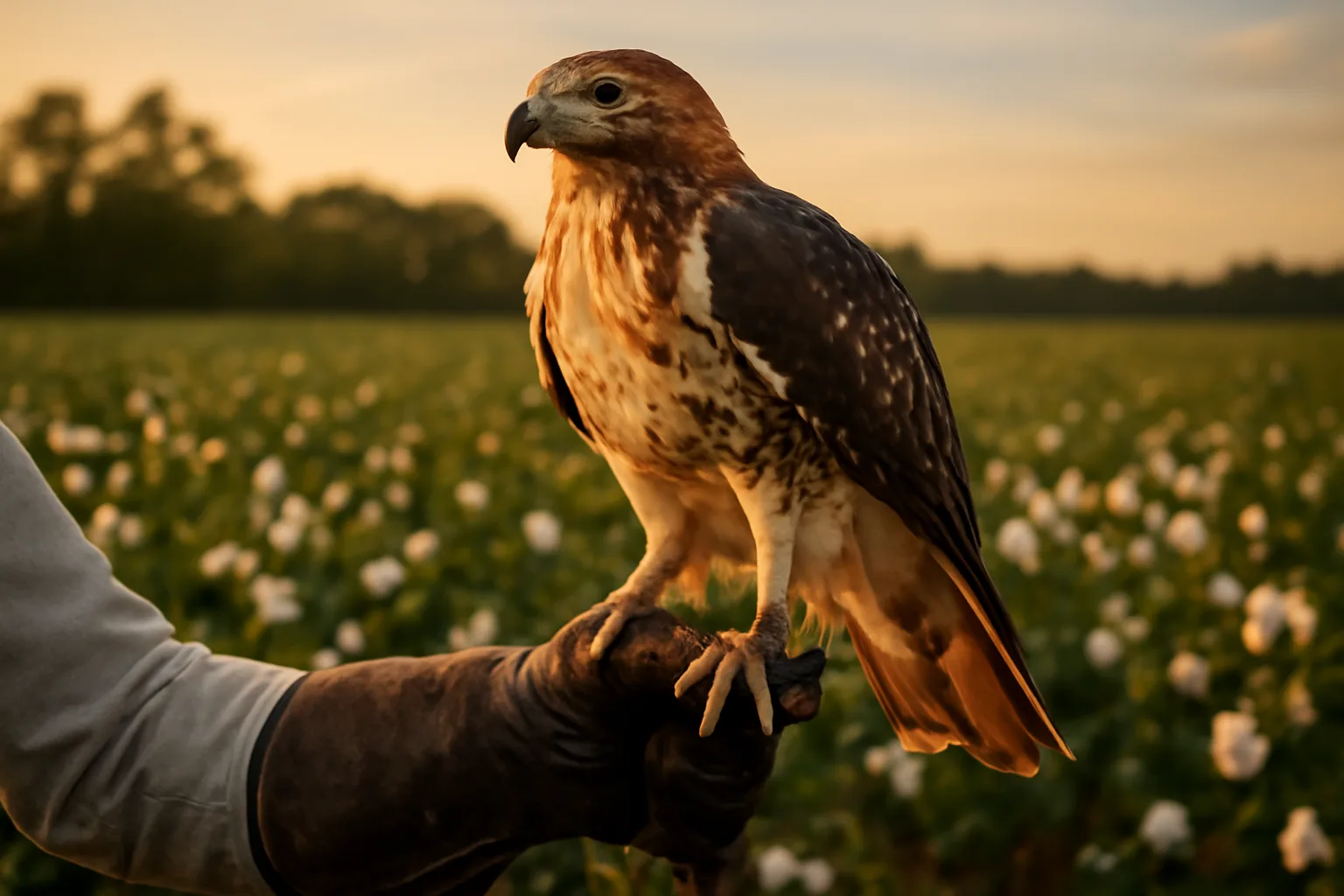
Apprentice is the entry point. You must be at least 14 years old, pass the state falconry exam with a score of 80% or higher, have your facilities inspected and approved, and be sponsored by a General or Master falconer with at least two years at that class [1]. Apprentice falconers are limited to one bird, either an American kestrel or a red-tailed hawk (the two species USFWS regulations list as appropriate for beginners), and cannot fly passage birds taken from the wild until the sponsor signs off that you're ready.
General class requires two years as a licensed Apprentice, a clean compliance record, and upgraded facility standards. You can hold up to three raptors at General, with a broader species list.
Master class requires five years at General. Most people won't think about that for a long time, and that's fine. Your goal right now is a solid Apprentice application.
Age note: if you're under 18, a parent or guardian must co-sign your state application. Confirm current age requirements directly with ADCNR before applying, because administrative rules get updated.
How do you find a falconry sponsor in Alabama?
Finding a sponsor is the hardest single step for most beginners. Alabama doesn't keep a public sponsor registry, so the legwork is yours.
The Alabama Falconers Association (AFA) is your best starting point. Attending a meet, a field day, or even just emailing the club puts you in a room with General and Master falconers who sponsor actively [4]. The North American Falconers Association (NAFA) annual meet also draws Alabama falconers and is worth attending if it lands anywhere close [5].
A sponsor takes on real responsibility for your development. They certify that your facilities meet standards before you can trap a bird, and they have to be willing to answer the phone when a bird is sick at 10 p.m. on a Saturday. That relationship goes both ways. Come prepared: know the basics, have already read the state regulations, and show that you're serious before asking someone to vouch for you.
Some beginners spend three to six months just finding a sponsor. Build that relationship before you spend money on equipment. A sponsor who has actually seen your mews and watched you handle a bird beats one who signs your paperwork from a distance.
For a detailed look at the full licensing paper trail, see our guide on the falconry license in Alabama.
What does the Alabama falconry exam cover and how hard is it?
The Alabama falconry exam covers raptor biology, behavior, husbandry, federal and state regulations, equipment, health and disease recognition, and trapping methods [3]. The federal framework sets an 80% passing score. Alabama administers the exam through ADCNR. Confirm current exam scheduling and format directly with the agency, because exam delivery (in-person vs. online, proctored vs. open-book) has varied by state and year.
The exam is not trivial. People fail it. The questions run detailed enough that casual reading of a pamphlet won't get you to 80%. The standard study resource is the "North American Falconry and Hunting Hawks" text by Frank Beebe and Harold Webster, along with NAFA study materials. You also need to read the full Alabama falconry regulations and 50 CFR Part 21 Subpart C before you sit down [1].
Plan for six to twelve weeks of genuine study. If you know a sponsor already, ask them to quiz you. The people who fail are almost always the ones who underestimated the regulatory section.
What facility requirements does Alabama require before you can get a bird?
Your mews (the housing structure for your raptor) must be inspected and approved by an ADCNR wildlife officer before you can trap or acquire a bird [3]. You can't buy a bird and figure out housing later. The inspection happens first.
Federal baseline requirements for an Apprentice mews include a minimum 8-by-8-by-6-foot weathering area or equivalent indoor space, secure latching on all doors and windows, no gaps larger than 1 inch in any wire mesh, perch options appropriate to the species, protection from predators (including domestic dogs and cats), and shelter from weather extremes [1]. Alabama can add requirements on top of these minimums, so read the state-specific rules carefully.
Your sponsor should sign off on the facility before the state inspection. That means they need to physically see it. A sponsor who inspects your setup can also tell you exactly what the inspector will flag before the official visit, which saves everyone time.
Common failures: improper perch material (sharp wire instead of astroturf or similar), inadequate overhead cover in the weathering yard, and latches that don't pass the "could a raccoon open this" test. Fix those before calling the inspector.
How much does falconry cost in Alabama?
Falconry costs vary enough that any single number misleads, so here's an honest breakdown by category.
Licensing fees are modest. The Alabama state falconry license fee and the federal permit application fee together typically run under $100, though you should confirm current amounts directly with ADCNR and USFWS because agency fee schedules change [1][3]. Neither fee meaningfully affects your total budget.
Equipment is where costs actually stack up. A starter kit for an Apprentice working a red-tail or kestrel includes jesses and hardware, a hood, a perch (block or bow), a leash, a scale, a lure, a giant hood or transport box, and a telemetry system. Telemetry alone (a transmitter and receiver) runs $200 to $600 new, and skipping it is a genuine mistake, because birds do fly off. Expect $600 to $1,200 for a functional but not fancy equipment set.
Mews construction costs swing hard. A DIY wood-framed weathering area can run $300 to $800 in materials. A contractor-built structure can hit $2,000 to $4,000. This is the most variable line in the budget.
Veterinary care is the wild card. A new raptor health exam at a licensed avian vet runs $75 to $200. Injuries and illness can cost far more. Budgeting $300 to $500 for a first-year vet contingency is not paranoid.
Food (quail, mice, day-old chicks) runs roughly $30 to $80 per month depending on what you're flying and your sourcing. Some falconers trap or raise prey. Most beginners buy from suppliers.
Total first-year realistic cost: $1,500 to $3,500. That's a real range, not a worst-case scenario.
| Cost category | Low estimate | High estimate |
|---|---|---|
| State + federal license fees | $25 | $75 |
| Equipment (starter kit) | $600 | $1,200 |
| Mews construction | $300 | $2,000+ |
| Veterinary (first year) | $150 | $500 |
| Food (12 months) | $360 | $960 |
| Exam prep materials | $50 | $150 |
| Total | ~$1,485 | ~$4,885 |
How long does falconry take in Alabama? What's the realistic timeline?
From first interest to legally flying your first bird, most Alabama beginners take 12 to 24 months. Here's what drives that range.
Finding a sponsor typically takes one to six months depending on your local falconry community and how hard you chase connections. This is the most unpredictable variable.
Studying for and passing the exam: plan for two to three months of real preparation. The exam can be scheduled fairly quickly once you're ready, but ADCNR schedules and inspector availability affect timing. Confirm current scheduling windows with ADCNR.
Building and passing a facility inspection: allow two to four months if you're building from scratch, less if you're modifying an existing structure. Inspection scheduling depends on ADCNR officer availability in your area.
Federal permit processing: USFWS typically processes Apprentice permits in 30 to 90 days after receiving a complete application, but processing times vary by regional office and season. The agency doesn't guarantee a timeline [2].
Trapping season: Alabama's raptor trapping season is set by state regulation and doesn't run year-round. If your licenses arrive after the season closes, you wait until the next one. That alone can add six months if the timing doesn't line up.
The 12-to-24-month figure isn't a bureaucratic exaggeration. It reflects real sequencing where each step depends on the one before it.
How do you trap your first bird in Alabama?
Apprentices in Alabama are limited to trapping passage birds (birds in their first year of life, still in juvenile plumage) of allowed species. The standard Apprentice species are the American kestrel and the red-tailed hawk [1]. Passage birds have not yet set up adult hunting territories and, if falconry doesn't work out, can be released back to the wild with a better-than-average survival rate. That's the conservation logic behind the restriction.
Trap selection for beginners is almost universally the bal-chatri (a wire cage with monofilament nooses on the outside, baited with a live mouse or sparrow) for kestrels, or a large padded leghold trap variant for red-tails. Your sponsor should walk you through trap construction and use before you go out alone.
Take-from-the-wild authority is tied to your license, not separate paperwork in most cases. In Alabama, the authority to take raptors from the wild flows from your state falconry license combined with your federal permit, but confirm the specific take procedures with ADCNR before trapping. Some states require a separate take authorization form. Check whether Alabama does.
Trap only during legal season, and never near populated areas, power lines, or places where you can't safely reach a trapped bird quickly. A bird that's been in a trap for more than a few minutes is stressed. Get to it fast.
What does the Apprentice period actually involve day to day?
The Apprentice period runs two years minimum, and those two years have a purpose. You learn by doing under someone who can tell you when you're wrong before the bird pays the price.
Day to day, an Apprentice falconer feeds the bird every day (no days off, ever), weighs the bird every day, and logs everything. Federal regulations require falconers to keep records of each bird held, including acquisition, health events, and disposition [1]. Alabama may require additional record formats. Check the current state rules.
You'll train the bird to the fist, to the lure, and eventually to fly free and return. That process takes weeks to months depending on the bird's age and temperament when trapped. Your sponsor should be present for early free-flight sessions.
The two-year clock starts when your license is issued, not when you trap a bird. If you can't trap during your first season, the clock still runs. There's no shortcut. Some people use the Apprentice period to really deepen their knowledge. The ones who try to rush it often struggle at General class because the habits aren't solid yet.
How does Alabama compare to neighboring states for starting falconry?
Alabama's framework is broadly typical of southeastern states. The 80% exam threshold is the federal standard, the two-year Apprentice period is universal, and the species limits sit at the federal floor.
Georgia and Tennessee run similar structures. Arkansas has an active falconry community and a process largely parallel to Alabama's. See our guide on how to start falconry in Arkansas if you're near the state line. Florida has a larger licensed population and more organized club activity, which can make finding a sponsor somewhat easier.
The meaningful differences between states usually come down to licensing fees (which are small), facility inspection standards (which vary slightly), and how actively the state wildlife agency engages with the falconry community. None of those differences are large enough to justify moving states to get a falconry license.
If you're comparing the southeastern region, the sponsor-finding step is the real variable, and that's about local community density, not state regulation.
Where can you get help preparing for the Alabama falconry process?
The Alabama Falconers Association is the obvious first stop for in-state community connections [4]. NAFA (North American Falconers Association) publishes study materials and maintains a state contacts list that can point you toward Alabama falconers willing to mentor [5].
The USFWS falconry regulations and Alabama's ADCNR wildlife rules are the authoritative sources for current requirements. Use them as your primary reference, not summaries posted on forums [1][3].
For people who want a structured path through the exam and equipment choices without piecing it together from scratch, FalconryPath's $149 State Exam + Sponsor + Mews Kit is built for that pre-licensing phase. It won't replace your sponsor or your state agency interaction, but it can cut the time you spend figuring out what to study and what to buy first. Find it at /start.
Books worth owning: "Falconry and Hawking" by Philip Glasier is a practical reference, and the NAFA study guide is worth the cost if the exam is in your near future. Your sponsor may have copies they can lend you.
For a detailed breakdown of the Alabama licensing paperwork specifically, the falconry license in Alabama guide covers the forms, fees, and submission process step by step.
Frequently asked questions
Do you need a license for falconry in Alabama?
Yes. You need two: a state falconry license from the Alabama Department of Conservation and Natural Resources (ADCNR) and a federal falconry permit from the U.S. Fish and Wildlife Service. The state license comes first. Practicing falconry without both is a federal violation under the Migratory Bird Treaty Act. There are no exemptions for beginners or for birds held temporarily.
How much does falconry cost in Alabama?
State and federal license fees together are typically under $100 (confirm current amounts with ADCNR and USFWS). Equipment for a starter kit runs $600 to $1,200. Mews construction adds $300 to $2,000 or more depending on whether you build it yourself. Factor in veterinary care and food, and realistic first-year total costs land between $1,500 and $3,500 for most Apprentice falconers.
How long does falconry take in Alabama?
From first interest to legally flying a bird, expect 12 to 24 months. Finding a sponsor takes one to six months. Exam preparation takes two to three months. Facility inspection and federal permit processing add two to four months. If your licenses arrive after trapping season closes, you wait until the next season. The two-year Apprentice period begins the day your license is issued.
What birds can an Alabama Apprentice falconer fly?
Alabama Apprentice falconers are limited to one bird, either an American kestrel or a red-tailed hawk, taken as a passage bird (first-year juvenile) from the wild during the legal trapping season. These species are specified in federal Apprentice regulations. Your sponsor must approve your readiness before your first free-flight session. Confirm current Alabama-specific species restrictions with ADCNR.
How do I find a falconry sponsor in Alabama?
Contact the Alabama Falconers Association, attend their meets and field days, and connect with the North American Falconers Association's Alabama contacts. Your sponsor must hold a General or Master license with at least two years at that class. Come prepared with basic knowledge of the regulations before asking someone to sponsor you. The relationship works better when both parties can see you're serious before any paperwork is signed.
What score do you need to pass the Alabama falconry exam?
You need an 80% or higher, which is the federal minimum. The exam covers raptor biology, behavior, husbandry, trapping methods, equipment, disease recognition, and state and federal regulations. Most people study for six to twelve weeks using NAFA materials, the Alabama regulations, and 50 CFR Part 21. Confirm current exam scheduling and format with ADCNR before you register.
Does my mews need to be inspected before I can get a bird in Alabama?
Yes. Your housing facility must pass an ADCNR inspection before you can legally trap or acquire a raptor. Federal minimums require at least an 8-by-8-by-6-foot weathering area with secure latches, predator-proof mesh, appropriate perches, and weather protection. Your sponsor should physically inspect your setup before calling the state officer, so they can catch any issues first.
Can I start falconry in Alabama if I'm under 18?
Yes, with conditions. The Apprentice license is available to applicants as young as 14, but a parent or guardian must co-sign the state application for anyone under 18. Verify the current minimum age requirement directly with ADCNR before applying, since administrative rules can change and age requirements are sometimes updated.
How do I apply for the federal falconry permit after getting my Alabama state license?
After receiving your Alabama state license number, submit your federal permit application through the USFWS ePermits system. You'll need your state license number, your facility inspection approval documentation, and the application fee. Processing typically takes 30 to 90 days but varies by USFWS regional office. Confirm current processing times and fee amounts directly with the USFWS before submitting.
Is there a falconry trapping season in Alabama?
Yes. Alabama regulates the seasons during which raptors may be taken from the wild, and those windows don't run year-round. If your licenses are issued after the current season has closed, you'll wait until the next trapping season opens. Check the current Alabama falconry regulations through ADCNR for specific season dates, as they can change annually.
What records do I have to keep as a falconer in Alabama?
Federal regulations require falconers to maintain records for each raptor held, including species, band number, acquisition method, any health events, and final disposition. Alabama may require additional state-specific record formats. These records can be inspected by both state and federal wildlife officers. Ask your sponsor to show you their logbook setup so you can model yours before you trap your first bird.
How long is the Alabama falconry Apprentice period?
Two years, minimum. The clock starts on the date your state Apprentice license is issued, not when you trap a bird. There is no way to shorten it. After two full years with a clean record, you can apply to upgrade to General class, which increases your bird allowance from one to three and opens up more species.
Can I buy a raptor instead of trapping one in Alabama?
Yes, with restrictions. Apprentice falconers can acquire captive-bred raptors from licensed breeders in addition to or instead of trapping wild passage birds. Captive-bred birds must come with proper USFWS documentation (band or microchip). Wild-caught birds require take authorization. Confirm the current allowed acquisition methods for Apprentices with ADCNR, as the rules have nuances that vary by species.
Sources
- USFWS, 50 CFR Part 21 Subpart C, Falconry Standards and State Permit Procedures: Federal falconry permit required alongside state license; Apprentice species limited to American kestrel and red-tailed hawk; two-year Apprentice period; one-bird limit; 80% exam threshold; facility minimum dimensions; record-keeping requirements.
- Migratory Bird Treaty Act, 16 U.S.C. 703: Taking or possessing migratory birds without a valid permit is a federal violation under the Migratory Bird Treaty Act; federal falconry permit applied for after state license issued.
- Alabama Department of Conservation and Natural Resources, Outdoor Alabama: Alabama state falconry license required; exam administered by ADCNR; facility inspection required before bird acquisition; Alabama-specific rules apply on top of federal minimums.
- Code of Alabama 1975, Title 9 (Conservation of Natural Resources), Chapter 11: Alabama grants ADCNR authority to regulate the taking and possession of wildlife, including raptors used in falconry, and to set license and permit requirements.
- North American Falconers Association: NAFA publishes study materials for the falconry exam and maintains state contact lists for finding sponsors; hosts an annual meet drawing falconers nationwide.
- USFWS, Migratory Bird Program: USFWS administers migratory bird permits, including falconry permits, and delegated primary falconry regulation to states under the 2008 rule framework.