Last updated 2026-08-19
TL;DR
Starting falconry in Delaware means a DNREC permit that runs on 50 CFR 21.82, a supervised exam scored at 80 percent or better, a General or Master sponsor for two years, inspected mews, and a hunting license before you chase quarry. Confirm current forms, fees, and inspection timing with the Division of Fish and Wildlife. You cannot possess the bird first and paper it later.
Do you need a license for falconry in Delaware?
Yes. You need a Delaware falconry permit from DNREC Division of Fish and Wildlife, plus a Delaware hunting license before the bird takes quarry. Holding a raptor without authorization violates the Migratory Bird Treaty Act.[4]
Federal law is blunt. 16 U.S.C. 703 makes it "unlawful at any time, by any means or in any manner, to pursue, hunt, take, capture, kill, attempt to take, capture, or kill" migratory birds except as permitted.[4]
Delaware runs falconry on the federal chassis in 50 CFR 21.82.[1] Certified states took over day to day permitting after the 2008 rule change, so you do not mail a separate federal falconry permit to USFWS.[2] The state class permit is the permit that lets you hold the bird.
People talk about one falconry Delaware license. That phrase hides a stack. You need the class permit (Apprentice, General, or Master), a passed exam, a facility inspection, a sponsor if you are an Apprentice, and a hunting license when you hunt.[1][7][9] Bird moves later ride on Form 3-186A.[3]
I would not buy a trap or a hawk until DNREC and a sponsor have both said you are in process. Confirm the live application and any fee with the Division. I will not print a dollar figure I cannot tie to the current fee page.
If a friend swears Delaware is loose about this, that friend has not read the stack.
What is the paper path to start falconry in Delaware?
Exam, sponsor, inspection, permit, then bird. That order is not a suggestion, and skipping ahead is how people lose the whole thing before they start.
Start by reading 50 CFR 21.82 and 7 DE Admin. Code 3900.[1][6] Then find a General or Master falconer willing to sponsor you. Under the federal standard that sponsor is at least 18 years old and has at least 2 years of experience at the General level.[1] Sit the supervised exam and score at least 80 percent.[1] Put up housing that can pass inspection. File the current DNREC application (confirm the form name and fee with the Division). Only after the permit is issued do you acquire one legal apprentice bird and report it.[3][5]
Carry a valid Delaware hunting license when you hunt, and fly only where falconry is a legal method that day.[6][7][9]
I would take the exam before I poured a footing for a mews. Some people read the material and quit. Quitting is cheaper than a building you never use.
Already permitted in another certified state? Ask DNREC about class transfer. Your Delaware housing still gets looked at. I will not guess how many weeks that takes.
The same federal skeleton shows up in other state guides, including how to start falconry in California and how to start falconry in Arizona. The desk name changes. The 80 percent score does not.
How long does falconry take in Delaware?
Plan on months to get the Apprentice permit in hand, then at least 2 years before you can apply for General. Federal rules set the supervised exam at 80 percent or higher (50 CFR 21.82).[1] The apprentice term runs at least 2 years with at least 4 months of maintaining, training, flying, and hunting in each year (50 CFR 21.82).[1] Master class needs 5 more years at General.[1]
The uncontrollable piece is the front end. Delaware is small. The sponsor pool is small. A landlord or an HOA can stall a mews for a season. Inspections happen on the Division's calendar. Confirm timing with DNREC. Anyone who guarantees you a date is not the permit office.
I have no public dataset for average days to first bird in Delaware. The closest hard numbers are those federal minimums, not a state dashboard.
Start at 12 and you still need a parent or guardian, as the federal apprentice rules require.[1] Start at 30 and the 2 year clock is identical. Age buys you no shortcut. Hunting seasons, molt, and a lost bird can all stretch those 4 active months. Budget three calendar years in your head if you want General without panic.
Trapping still waits on the legal take season in the current wildlife regulations.[6] Do not set a bal-chatri because a Facebook group said September. Read this year's text.
How much does falconry cost in Delaware?
There is no official Delaware first-year total. DNREC does not publish a falconry cost study. Confirm every government fee on the current license page and with the falconry desk.[7]
The money that actually hurts is not the permit. It is lumber, food, and the first vet bill.
A DIY mews often lands roughly $400 to $2,500 in materials if you already own tools and have a legal place to put it. Contractor builds run higher. A usable glove, Aylmeri jesses, leash, swivel, and a gram scale often sit roughly $150 to $400 if you buy decent, not decorative. Frozen quail and rodents for a red-tail commonly run several hundred dollars in year one. Prices move with feed markets.
Telemetry is the classic beginner money pit. A used setup can be a few hundred dollars. New can pass $1,000. I would not buy telemetry until the bird is actually hunting off the creance.
Keep a cash reserve for an avian vet. 50 CFR 21.82 requires you to keep raptors in humane and healthful conditions, which means real medical care when something goes wrong, not hope.[1]
Skip engraved perches and imported furniture. Skip mystery starter kits full of cut jesses you will throw away. The ranges below are practitioner ballparks, not a lab result.
| Line item | Honest range | What I'd do |
|---|---|---|
| State falconry permit | Confirm with DNREC | Do not trust an old blog number |
| Hunting license | Confirm on the DNREC fee page | Required before you hunt [7] |
| Exam | Confirm with DNREC | Some states charge, some do not |
| Mews build (DIY) | roughly $400 to $2,500 | Build after you pass the exam |
| Glove, jesses, leash, scale | roughly $150 to $400 | Buy used only if you know the seller |
| Telemetry | roughly $400 to $1,200 | Wait until the bird is hunting |
| Food, year one | roughly $400 to $1,000 | A chest freezer beats fancy hoods |
| Vet reserve | $200 to $600 sitting in cash | Do not skip this |
Honest all-in for a careful first year, permit through food, often sits somewhere around $1,500 to $5,000. For another state's cost breakdown (same federal chassis, different desk), see falconry cost in Alabama.
FalconryPath publishes a $149 one-time State Exam + Sponsor + Mews Kit if you want the paper checklists bundled. You do not need it to apply. The federal text and the Delaware regs are public.
What score do you need on the Delaware falconry exam?
You need at least 80 percent. 50 CFR 21.82 states, in the examination standard the states use, "You must correctly answer at least 80 percent of the questions on a supervised examination."[1]
Delaware administers or approves that supervised test. Confirm where it is given, whether there is a fee, and what study packet (if any) the Division still hands out. I would not drive to Dover on a rumor about walk-in testing.
The exam is the easy part. It covers law, raptor ID, field care, housing, and basic disease. NAFA's beginner pages are a sane place to start reading before you pester a sponsor.[10] Cornell's species accounts help you stop guessing at silhouettes.[11][15]
Fail it and you retake on the Division's schedule, not yours. Pass it and you still have no bird until inspection and the permit catch up.
Federal class thresholds sit behind that score. They are the same numbers every certified state starts from, unless the state writes a tighter rule.
| Class | Minimum age | Time in prior class | Federal bird cap | Sponsor |
|---|---|---|---|---|
| Apprentice | 12 | none | 1 | Yes |
| General | 16 | 2 years apprentice, 4 active months each year | 3 | No |
| Master | 16 | 5 years as General | 5 wild (read current captive-bred text) | No |
Those caps and ages come from 50 CFR 21.82.[1] Delaware can be stricter. Confirm the live state text before you plan a second bird.
How do you find a falconry sponsor in Delaware?
You ask working General and Master falconers until one says yes. There is no public Delaware sponsor vending machine.
Federal rules require a sponsor for the Apprentice term. That person holds General or Master, is at least 18, and has at least 2 years at General.[1] Some states keep an informal list at the wildlife desk. Ask DNREC if they will share names. If they will not, use NAFA channels and Mid-Atlantic field meets.[10]
Delaware has three counties. The hunting is real. The falconer density is not California. Expect to drive. Expect to help at the mews for months before anyone writes a letter. That is normal, and it is the whole point.
I would not pay a stranger for a signature. A sponsor who wants cash up front for the letter is a bad bet. A sponsor who wants you to show up, hold a bird, and clean the weathering area is doing the job.
If your sponsor quits, you need another one to stay legal as an Apprentice. Call the Division the week it happens. Do not hide it.
What mews and facilities does Delaware inspect?
DNREC inspects the housing you will actually use before it issues the permit. 50 CFR 21.82 requires humane, healthful, inspectable facilities, with indoor mews and outdoor weathering that keep the bird safe from weather, predators, and escape.[1]
Read the federal facility language yourself. It is performance based more than a single magic dimension, but inspectors still fail sloppy wire, lead-head nails, death-trap perches, and a dog door that opens into the mews. Clean water. A perch the bird will actually use. Shade. A floor you can scrape.
I would build after I passed the exam and walked a working mews with my sponsor. Building first is how people end up with a pretty shed that fails inspection.
Local rules can kill a legal federal mews. A New Castle rental, a Sussex HOA, and a Kent farm all carry different headaches. Get the landlord in writing. An inspection sticker from Dover does not override a lease.
Confirm what photos, sketches, or on-site visits the Division wants this year. Do not invent a two-week inspection promise for yourself.
What hawk can a Delaware apprentice keep?
An Apprentice falconer may possess no more than one raptor under 50 CFR 21.82.[1] The federal apprentice list is American kestrel, red-tailed hawk, and red-shouldered hawk (goshawk only if you are in Alaska).[1][11][15]
Delaware can narrow that list. It cannot legally widen it for an Apprentice. Confirm the current state species list with DNREC before you trap or write a check.
Wild take, if the state opens it, is usually a passage (hatching-year) bird inside the dates in 7 DE Admin. Code 3900.[6] Apprentices do not take nestlings under the federal standard.[1] You also do not take eagles. The Bald and Golden Eagle Protection Act sits on top of falconry class rules.[12]
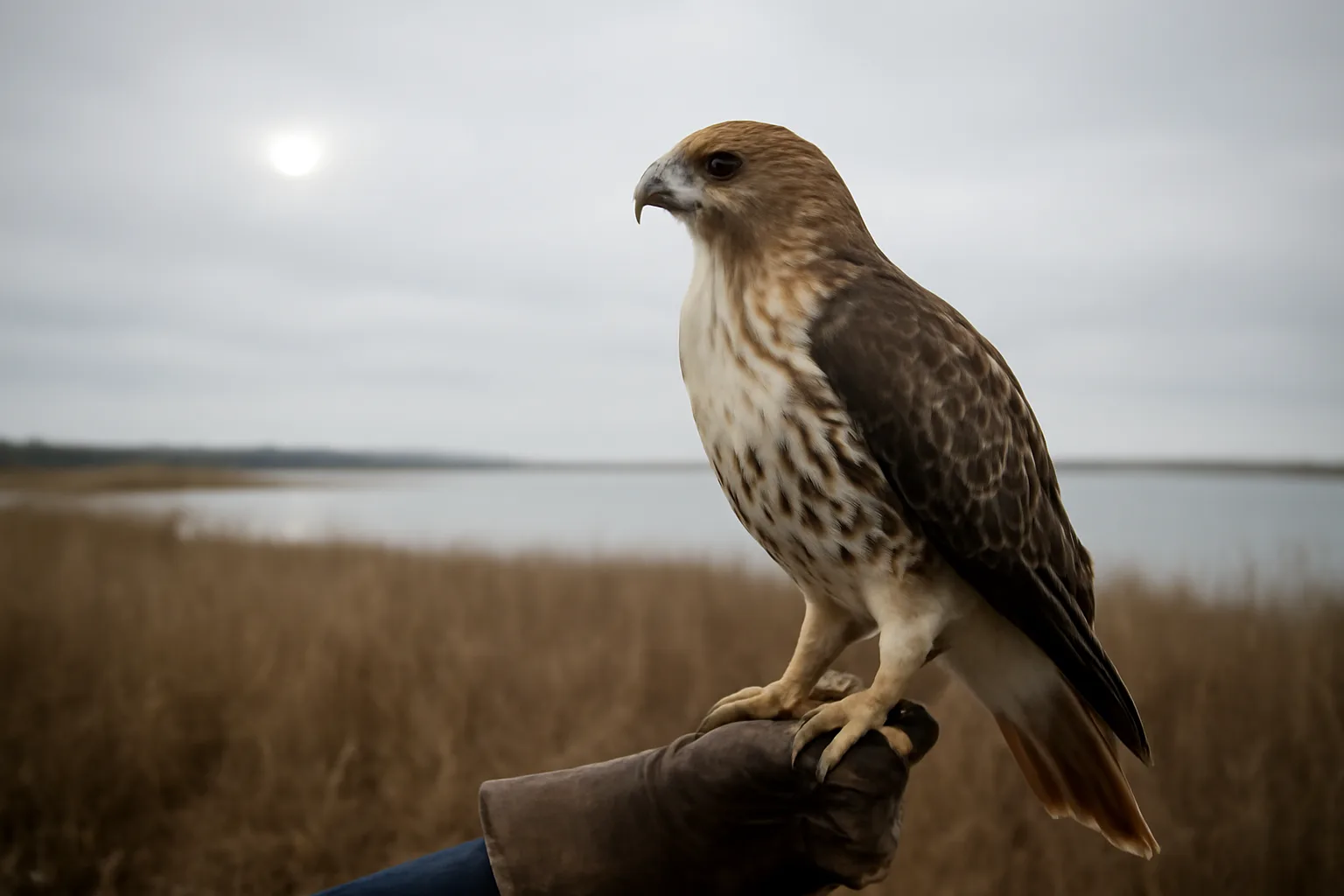
A hybrid is not an apprentice bird. A passage red-tail from a farm you have permission to work is the boring, correct first bird for most people in this state. Red-tails winter hard on Delaware edges and marsh dikes. Learn that silhouette before you buy a trap.[11]
Do not hold a bird for a friend. Do not "borrow" a kestrel. The 3-186A is how legal birds move.[3]
Do you also need a Delaware hunting license?
Yes, if you hunt. Falconry is hunting the moment the hawk takes quarry. Title 7 Chapter 5 is the license chapter, and DNREC sells the licenses.[7][9][14]
The falconry permit covers possession and the method. It does not replace the hunting license, hunter education rules, or bag limits on rabbits, squirrels, and other legal quarry. Confirm first-time hunter education, any apprentice hunting license, and current fees on the live DNREC pages. I will not invent a license price or a birth-date cutoff that may have moved.
Buy the license in your own name. Carry it. If you fly a bird on a game farm or a permitted preserve, read that property's rules too. A preserve stamp is not a substitute for understanding the regular season.
Nonresidents should ask DNREC whether Delaware even issues them a falconry class, and which hunting license they must hold. Do not assume a Maryland or Pennsylvania card works here.
Where can you hunt with a raptor in Delaware?
On land you may legally hunt, during a season that lists your quarry, with a method of take that includes falconry that day. That sentence is the whole access rule.
Private land needs clear permission. Ask the owner. Get it in a text or a note if you can. Falconry does not create a right to walk someone's bean field because the hawk went that way.
Public wildlife areas carry their own use rules. Read the current DNREC wildlife area pages before you park.[8][14] Some units want extra permits or close for management. National wildlife refuges run separate hunt brochures. I will not tell you Bombay Hook or Prime Hook is open to falconry. Read that refuge sheet for this year.
Delaware is small, wet, and posted. The limiting factor after your permit is access, not theory. If you cannot name two places you may legally fly next January, you are not ready to trap.
Road hunting from a car is its own legal mess. Do not turn a highway pull-off into a trap site. Confirm vehicle and right-of-way rules in the current wildlife regulations and Title 7 before you get cute.[6]
What reports and bands does Delaware falconry require?
Every legal bird move needs a 3-186A (paper or the federal ePermits falconry module) inside the federal window, which is 10 calendar days for acquisition, transfer, release, loss, rebanding, or microchipping under 50 CFR 21.82.[1][3][5]
Wild-caught birds get a standard federal/USGS band. The Bird Banding Laboratory is the banding backbone for those markers.[13] Captive-bred birds use the black federal band or the microchip option in the current CFR text. Confirm which band packet DNREC issues and who is allowed to apply it. Do not put a homemade ring on a wild red-tail and call it done.
Keep copies. Inspectors ask. If a bird dies or disappears, file the 3-186A anyway. Silence looks worse than a hard day in the field.
Releasing a wild-taken bird back to the wild carries its own federal conditions. Read them before you "set it free" because training went badly. A permit bird is still a permit bird until the form says otherwise.
What first-year mistakes stall Delaware falconers?
Buying the bird first. That is the career-ending one.
The others are slower. Building a mews for a house you do not control. Skipping the sponsor and hoping DNREC will "work with you." Trapping on posted land. Ignoring food weight and then acting shocked when a thin passage bird crashes. Spending $800 on telemetry and $40 on a glove.
I would spend year one on the exam, a clean mews, a boring red-tail, a chest freezer, and a vet fund. I would not buy a hybrid, a travel box the size of a steamer trunk, or a leather hood I cannot block.
Another stall: treating Facebook as the regulation. 7 DE Admin. Code 3900 and 50 CFR 21.82 are the text. Group chats are not.[1][6]
If you move, start the transfer talk before the truck is loaded. A bird in a temporary garage in Newark with an old out-of-state card is how people land in real trouble.
How does starting falconry in Delaware compare to other states?
The federal floor is the same everywhere. The desk, the sponsor pool, and the land base are not.
Delaware uses 50 CFR 21.82 like how to start falconry in Colorado and how to start falconry in Alabama.[1] You still need 80 percent, a sponsor, inspected housing, and class time. What changes is who answers the phone and how much public land you can actually fly.
California's paper load is heavier in practice because the state is huge and the culture is thicker. Read falconry license in California if you might move west. Arizona's take culture is different from a three-county Atlantic state. Its license path is still the same federal classes. See falconry license in Arizona.
I would rather start in Delaware with one honest sponsor and two farms I can hunt than collect permits in a bigger state I visit twice a year. Reciprocity rumors are mostly wrong. Confirm every crossing with both states.
Readers who want those checklists in one pile can use /start. FalconryPath is an independent publisher, not a law firm and not DNREC.
Frequently asked questions
Do you need a license for falconry in Delaware?
Yes. You need a DNREC falconry permit under 50 CFR 21.82 plus a Delaware hunting license before you hunt. The Migratory Bird Treaty Act bans unauthorized possession. Confirm the current form and fee with the Division of Fish and Wildlife. Do not hold a bird while the paper is in the mail.
How much does falconry cost in Delaware?
Government fees are the small line. Confirm them with DNREC. A careful first year often lands roughly $1,500 to $5,000 once you add a DIY mews, basic furniture, food, and a vet reserve. Telemetry can add several hundred more. No state cost study exists. Fancy kits are usually a waste.
How long does falconry take in Delaware?
Getting the Apprentice permit can take months because of sponsors and inspection. Federal rules then require at least 2 years as an Apprentice with 4 active months each year before General (50 CFR 21.82). Master takes 5 more years at General. DNREC does not publish a processing-time guarantee.
Can you start falconry in Delaware at 12?
Federal standards set the Apprentice minimum at 12 years old, with a parent or guardian as required by 50 CFR 21.82. You still need a sponsor, an 80 percent exam score, inspected housing, and DNREC's permit. Confirm any extra state age rules with the Division before you study.
Is the federal falconry permit separate in Delaware?
No separate USFWS falconry permit is required once you hold the Delaware permit in a certified state. That is the point of the 2008 federal rule and 50 CFR 21.82. You still use federal Form 3-186A (or ePermits) when a bird is acquired, transferred, lost, or released.
Can a Delaware apprentice trap a wild red-tail?
Yes, if your permit is in hand, the species and age class are legal, and you are inside the take season Delaware sets in its wildlife regulations. Apprentices are limited to one bird and to American kestrel, red-tailed hawk, or red-shouldered hawk under 50 CFR 21.82. Confirm dates and any tighter state limits with DNREC.
Does Delaware require hunter education for falconry?
If you hunt quarry, you need a valid Delaware hunting license, and first-time hunters generally must meet hunter education rules. Confirm the current education requirement, apprentice hunting license options, and exemptions on the DNREC license pages before you buy. Falconry paper does not replace hunter education.
Can you keep a falconry bird in a New Castle County backyard?
State falconry housing standards are the first gate, then local zoning, leases, and HOA rules. 50 CFR 21.82 requires humane, healthful, inspectable facilities. A legal state mews can still violate a rental agreement. Get the landlord in writing before you build. DNREC inspection does not override a lease.
How do you transfer a falconry permit into Delaware?
Ask DNREC and your old state in the same week. Certified-state class often transfers if you meet Delaware's requirements, but your new mews still gets inspected. Do not move a bird across state lines until both desks tell you the 3-186A and any import steps are done. Confirm every step. I will not guess the timeline.
What happens if your sponsor drops you?
You need a replacement sponsor to stay legal as an Apprentice under the federal standard. Call DNREC as soon as the relationship ends. Do not sit on a bird with a dead sponsor letter and hope nobody notices. Finding a second sponsor in Delaware can take time, so keep the relationship honest and the bird well cared for.
Can you fly a hybrid as an apprentice in Delaware?
No. 50 CFR 21.82 limits Apprentices to American kestrel, red-tailed hawk, and red-shouldered hawk (plus goshawk only in Alaska). Hybrids wait until a higher class, and even then Delaware can be tighter. Read the current CFR text and ask DNREC before money changes hands.
Is falconry legal in all three Delaware counties?
The state permit is statewide. Hunting access is not. You still need a hunting license, legal quarry seasons, and permission or a lawful public-land opening. New Castle suburbs, Kent farms, and Sussex woods all carry different access problems. County lines do not create a shortcut around 50 CFR 21.82 or Title 7.
Do you need landowner permission to hunt with a hawk in Delaware?
Yes on private land. Ask, get it clear, and do not lean on a verbal maybe. Public wildlife areas carry their own use rules. National wildlife refuges run separate hunt brochures. Falconry does not grant a right to trespass. If you cannot explain where you will fly, you are not ready to trap.
Who do you call at DNREC about falconry?
Call the Division of Fish and Wildlife, not a medical board and not USFWS for the state class permit. Confirm the current falconry contact on the DNREC fish and wildlife site before you drive to Dover. Bring your sponsor's name, your housing plan, and a question list. Be polite. That person is the whole gate.
Sources
- eCFR 50 CFR 21.82 Falconry standards and falconry permitting: Federal falconry standards require an 80 percent supervised exam, Apprentice/General/Master classes, minimum ages 12 and 16, a 2-year apprenticeship with 4 active months per year, a qualified sponsor, inspected facilities, apprentice species limits, possession caps, and 10-day 3-186A reporting.
- Federal Register E8-23759 Migratory Bird Permits; Changes in the Regulations Governing Falconry (2008): The 2008 federal rule revised U.S. falconry regulations and provided for certified states to administer falconry permitting so a separate federal falconry permit is no longer required in those states.
- U.S. Fish and Wildlife Service Migratory Bird Treaty Act of 1918: The Migratory Bird Treaty Act makes it unlawful to take or possess migratory birds except as permitted by regulation.
- U.S. Fish and Wildlife Service ePermits falconry module (FALCP): Federal electronic reporting for falconry bird acquisitions and dispositions is filed through the FWS ePermits falconry system.
- Delaware Administrative Code Title 7, 3900 Wildlife: Delaware wildlife regulations set seasons, methods of take, and other state hunting rules that apply to falconry quarry and wild raptor take.
- DNREC Division of Fish and Wildlife licenses: Delaware hunting licenses are issued through the Division of Fish and Wildlife, and current fees must be confirmed on the live license page.
- DNREC Division of Fish and Wildlife wildlife areas: Public hunting on Delaware wildlife areas is subject to Division wildlife-area use rules beyond a falconry permit.
- Delaware Code Title 7, Chapter 5, Subchapter I hunting licenses: Delaware statute in Title 7 Chapter 5 requires a hunting license (with listed exceptions) to hunt in the state.
- North American Falconers Association Beginners page: NAFA directs prospective falconers to study the craft and work with experienced permitted falconers before acquiring a bird.
- Cornell Lab of Ornithology All About Birds Red-tailed Hawk overview: The red-tailed hawk is a widespread Buteo and a primary apprentice falconry species under federal rules.
- U.S. Fish and Wildlife Service Bald and Golden Eagle Protection Act: Bald and golden eagles have separate federal protections and are not apprentice falconry birds.
- USGS Bird Banding Laboratory: Federal bird bands used on wild raptors are administered through the USGS Bird Banding Laboratory system.
- DNREC Division of Fish and Wildlife hunting program: Delaware hunting seasons, methods, and license rules for quarry are administered by the Division of Fish and Wildlife hunting program.
- Cornell Lab of Ornithology All About Birds American Kestrel overview: The American kestrel is a small falcon on the federal apprentice species list.