Last updated 2026-08-18
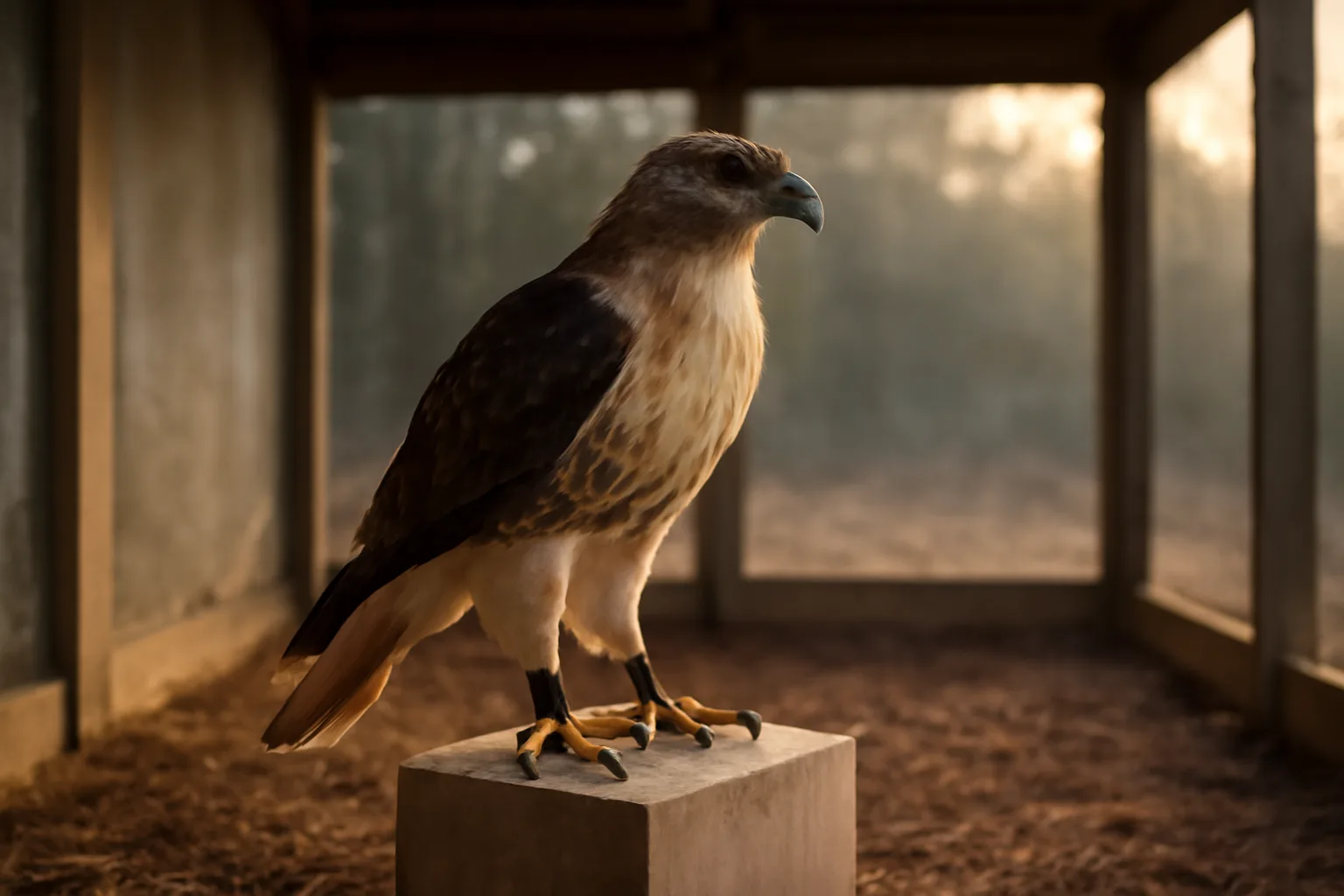
TL;DR
Falconry in Arkansas needs an AGFC falconry permit, a hunting license, an 80 percent exam, a facility inspection, and a 2-year apprenticeship under 50 CFR 21.82. The permit fee is the small line. Housing, food, and gear are the real first-year cost. Confirm every current AGFC fee before you pay. No separate federal falconry permit is issued in a certified state.
How much does falconry cost in Arkansas?
Most of your falconry cost in Arkansas is housing, food, and gear, not the state permit. Plan a few hundred to a few thousand dollars in year one, then confirm every official fee with AGFC. Federal rules still force the exam, the inspection, and a 2-year apprenticeship [1].
The permit line is the one people obsess over. It is usually the cheap line. AGFC publishes hunting license prices on its license fee page, and that is the number you can check tonight [6]. The falconry permit fee sits in the same agency. I will not quote a dollar figure for that permit here. Those fees get revised. A stale number is worse than no number.
What you feel in your bank account is lumber, welded wire, a scale, leather, then meat. A shed conversion that can pass a 50 CFR 21.82 look-over often lands in a roughly $400 to $2,000 materials window if you already have a dry outbuilding. That is a builder's range, not an AGFC study. Nobody has good statewide data on what Arkansas apprentices actually spend. If someone hands you one tidy "average cost of falconry," they invented it.
I would spend first on a tight, clean mews and a reliable gram scale. I would not spend first on a carved hood or a display glove.
| Line item | What you actually pay | Where the number comes from |
|---|---|---|
| Falconry permit | Current AGFC fee | Confirm with AGFC |
| Hunting license | Current AGFC resident or nonresident price | AGFC license fee page [6] |
| HIP registration | Usually handled in the license buy | 50 CFR 20.20 [4] |
| Federal duck stamp | Current face value, only if you hunt waterfowl | 16 U.S.C. 718a [7] |
| Mews and weathering area | Often $400 to $2,000 DIY | Market materials, inspected to 50 CFR 21.82 [1] |
| Handling furniture | Often $150 to $600 to start | Market prices, sponsor list |
| Food after you have a bird | Often $40 to $150 a month | Feeder-bird market, not a statute |
| Vet cash reserve | A few hundred dollars held back | Your clinic |
Compare the paper stack with falconry cost in Alabama or falconry cost in Georgia if you live near a state line. The federal floor does not change. The license receipts do.
Do you need a license for falconry in Arkansas?
Yes. You need an Arkansas falconry permit before you take, possess, or fly a raptor for falconry. A hunting license alone is not enough. A duck stamp is not enough. Calling the bird a pet is not a legal workaround [2].
The Migratory Bird Treaty Act is blunt. 16 U.S.C. 703 says it is unlawful "to pursue, hunt, take, capture, kill" migratory birds "unless and except as permitted by regulations" [2]. Almost every hawk and falcon you have seen in an Arkansas pine is covered by that statute. The permit is the exception, not a club card.
Since the 2008 federal rewrite, certified states issue the falconry permit. You do not apply to the U.S. Fish and Wildlife Service for a separate federal falconry permit if you live in a certified state [8]. Arkansas runs that certified program, so AGFC is your permitting agency. You still follow 50 CFR 21.82, because that rule is the floor the state program has to meet [1].
You also hold whatever AGFC hunting license covers the quarry you chase [6]. If you are 16 or older and you hunt migratory waterfowl with the hawk, you carry a Federal Migratory Bird Hunting and Conservation Stamp [7]. If you hunt migratory game birds, you register with the Harvest Information Program [4].
No permit, no bird. People get this wrong when they "rescue" a hawk off a roadside. That is a different legal problem, and it is not falconry. If you want the bird, you walk the paper path first.
How long does falconry take in Arkansas?
The apprenticeship alone takes at least 2 years. That clock is federal. 50 CFR 21.82 requires you to practice falconry at the Apprentice class for at least 2 years, and to have a raptor for at least 4 months in each of those years [1]. Passing the exam on a Saturday does not shorten it.
The part nobody can calendar for you is the wait before the clock starts. You need a General or Master sponsor who will take you. Some Arkansas apprentices find someone in a few weeks. Some look for a year. AGFC does not publish a clean sponsor wait-time study. Ask the agency how they want the sponsor documented, then start calling permitted falconers. Be useful. Do not ask a stranger to sign and vanish.
After you have a sponsor, you study, you sit the supervised exam, you build or fix facilities, and AGFC inspects. Federal rules require a score of at least 80 percent [1]. How long the agency takes after inspection is an AGFC variable. Confirm it with them. Do not plan a trapping weekend around a guess from a forum.
Then you hunt through two seasons at minimum. General class is the next rung. Master class takes another 5 years at General under the federal ladder [1]. If you want the honest total to Master, think 7-plus years of permitted practice. This is not a one-winter hobby.
I would not buy a house around the mews until a sponsor has actually walked the yard. Facilities fail inspection. People stall. The 2-year rule only starts once you are a permitted apprentice with a bird on the books.
What federal rules control the Arkansas paper path?
50 CFR 21.82 is the rule that shapes Arkansas falconry paperwork. Certified states may write stricter rules. They may not write weaker ones [1]. If AGFC and the federal text disagree in your head, you follow both, and you ask the agency which form they want.
The federal class ladder is simple. Apprentice. General. Master. An apprentice is at least 12 years old, has a sponsor who is a General or Master, keeps one raptor, and stays in that class for at least 2 years with a bird on hand at least 4 months each year [1]. A sponsor may not carry more than three apprentices at once under that same rule [1].
The exam line is the one people quote, and they should. 50 CFR 21.82 says you must "correctly answer at least 80 percent of the questions on a supervised examination" before the state can permit you [1]. That test runs under the state program, not a national club.
The 2008 U.S. Fish and Wildlife Service rule is why you are not mailing a federal falconry application to Washington. That rewrite let certified states take over permitting [8]. You still report birds on the federal 3-186A system when you acquire, transfer, or lose one [1]. The state permit did not erase federal reporting.
I would print 21.82 and read it once with a highlighter before I called a sponsor. It is not exciting. It will save you from building the wrong mews.
What hunting licenses and stamps sit on top of the falconry permit?
A falconry permit lets you possess the raptor. It does not, by itself, let you hunt rabbits, squirrels, quail, or ducks. You still need the AGFC hunting privilege that covers that quarry, and you hunt only in the open season for that species [6]. Confirm the current license names and prices on the AGFC fee page. Do not copy a price out of an old forum post.
HIP is the quiet extra. If you hunt migratory game birds (doves are the usual apprentice example), 50 CFR 20.20 requires Harvest Information Program registration [4]. In practice you do that while you buy the state license. It is easy to skip if you only read the falconry addendum and never open the migratory bird chapter.
Waterfowl is a separate pile. 16 U.S.C. 718a says no person 16 or older shall take migratory waterfowl without carrying an unexpired Federal Migratory Bird Hunting and Conservation Stamp [7]. Confirm the current face value before you order one. If you never fly at ducks, skip it.
Nonresident paper costs more. Always. If you live in Memphis or Texarkana and hunt Arkansas, check the nonresident table, not the resident one [6]. Falconry does not get you a discount.
I would buy the hunting license the week the falconry permit is issued, not the morning you want to trap. Counters get busy. Online portals go down. You do not want that fight on opening day.
How do you find a sponsor and sit the exam in Arkansas?
You find a permitted General or Master who will put their name on you. Federal rules require that sponsor [1]. AGFC will tell you how they want the relationship shown on the application. I cannot invent their current form name or a processing promise.
There is no public, complete, official list of every Arkansas sponsor with a phone number that I can honestly cite. Clubs and word of mouth are how most people do this. Show up willing to carry a giant hood, clean a mews, and drive. Sponsors do not owe you a bird. They owe the sport a student who will not wreck a hawk.
Study the federal rule, the state code AGFC points you to, raptor husbandry, and the quarry you will actually hunt here. The pass line is 80 percent on a supervised exam [1]. It is not an open chat with a ranger. If you cannot name the parts of a jess or say why a hawk gets fat in December, you are not ready.
FalconryPath publishes a $149 one-time State Exam + Sponsor + Mews Kit that some readers use to organize the study list and the facility checklist. It is a publication. It does not file AGFC paperwork and it does not assign you a sponsor.
I would not sit the exam until a sponsor has said you are close. Retakes waste days you could have spent building the weathering area. Confirm exam dates, locations, and any sitting fee with AGFC. Those are board-variable facts.
What does a legal mews actually have to include?
A legal mews is a raptor house that lets the bird stand, perch, bate, and fully extend its wings without hitting junk, and that keeps raccoons, dogs, and thieves out. 50 CFR 21.82 sets the federal facility standard the inspector is measuring you against [1]. Arkansas may add detail. Confirm the checklist AGFC uses before you buy lumber.
The federal text cares about function, not a pretty floor plan. The building has to be large enough for the raptor to fly if it wants, and high enough that the tallest bird is not scraping the roof when it sits up [1]. A weathering area, if you use one, needs the same basic protection from predators and weather. Chicken wire is a joke against a raccoon. Use welded wire.
I would convert a small existing shed before I built a custom timber box. Dry floor. Solid roof. A door that latches. A perch that does not rot in an Arkansas August. A bath pan. Shade. That passes more inspections than a Pinterest mews with decorative slats a skunk can walk through.
Do not put a bird in the building before the inspection. The whole point of the inspection is that the house exists first [1]. If you fail, you fix it and ask for another look. There is no honest published average for how many Arkansas mews fail the first visit. Budget a second hardware-store run.
Skip glass display walls and Wi-Fi cameras as year-one requirements. A cheap trail camera pointed at the door is plenty if you want eyes on the latch.
What does first-year gear and food really run?
Starter furniture is a glove, jesses, a swivel, a leash, a bath pan, perches, and a scale that reads in grams. A careful shopper often lands that pile in a roughly $150 to $600 window if they buy new mid-grade leather and a decent digital scale. That is a market range. It moves with shipping and hide prices. It is not an AGFC figure.
Telemetry is the line that wrecks budgets. A used or new radio setup commonly sells somewhere around $400 to $1,200 depending on brand and whether you buy a complete kit. I would not buy it in month one. I would fly a creance until the bird is reliable, then decide. Plenty of red-tails have been trained without a $900 transmitter on day one.
Food is the quiet monthly bill. Once you have a hawk, figure something on the order of $40 to $150 a month in commercially raised quail, mice, or rats, depending on the species and how hard you are flying it. Nobody has a published Arkansas feeder-bird index. Ask your sponsor what they actually feed in January, not what a catalog upsells.
Do not feed mystery roadkill. Disease and lead fragments are real problems. If a friend shoots a rabbit for you, ask what metal left the barrel.
Vet care is thin on the ground. Arkansas does not have a long public list of raptor clinics that I can cite as complete. I would keep a few hundred dollars liquid and know which exotic or avian practice you will call at 8 p.m. on a Sunday. Driving to a larger city is normal. That gas is part of the cost.
Can you trap a wild hawk in Arkansas or do you buy one?
Most apprentices still start on a wild passage bird if the state season and species list allow it. The classic legal beginner birds under the federal floor are an American kestrel or a red-tailed hawk [1]. Both live in Arkansas year-round, which is why that pairing is not a fantasy reading list [9] [10]. Confirm the current AGFC take list, dates, and reporting steps before you set a bow net. I will not invent a trapping opener.
A wild passage red-tail usually costs you gas, a trap, and time. That is the point. You learn the bird you caught. Buying a pricey captive-bred hawk as an apprentice is how people skip the hard part and still fail at weight control. I would not do it.
If AGFC allows a captive-bred bird in your class, you still need the same permit, the same 3-186A acquisition report, and the same housing [1]. A breeder invoice is not a permit. Interstate shipment adds another layer of paper. Confirm it before money leaves your account.
Eyases (nestlings) are not the apprentice path under the federal rule set most people are reading [1]. Leave nest trees alone. If someone offers you a downy hawk out of a pine, that is a bad day waiting to happen.
Band the bird the way AGFC and 50 CFR 21.82 tell you to band it. Do not invent your own color scheme.
What paper do you file after you have a bird?
You report acquisition, transfer, release, death, and rebanding. Federal rules put that report on Form 3-186A through the Fish and Wildlife Service electronic system [1]. The deadline people quote from 50 CFR 21.82 is 10 calendar days [1]. Confirm the method AGFC wants, because some states still want a copy in their own inbox too.
Keep a copy of the permit, the inspection notes, the hunting license, HIP proof if you need it, and every 3-186A confirmation. A game officer on a WMA does not want to hear that the PDF lives on a phone that is dead.
If the bird dies, you still file. You do not bury the problem in the woods and hope. If you transfer the bird to another falconer, both sides need the paper clean [1]. Report lost bands. That is why the banding lab still matters when a band shows up on a dead hawk two counties away.
I would make a single folder, paper and digital, the night the permit arrives. Label it. Put the sponsor's number on the inside cover. Future you is tired and standing in a field. Future you will not remember file names.
Do not post trap-site coordinates and permit scans on social media. That is not a statute tip. That is how birds and gear walk off.
What is a waste of money in year one?
A custom mews that looks like a cabin is a waste if the latch fails. Imported display hoods are a waste before you can keep a red-tail at flying weight for two weeks. A $2,000 captive-bred bird is a waste if you do not yet have a sponsor, a passing score, and an inspected house [1].
Club leather in year one is mostly ego. A sound glove from a working maker is enough. I would rather put that extra cash into feeder birds and a tank of gas to go hunt public land the right way.
Telemetry can wait if the bird is on a creance and you have fields that close with woods you can walk. Buy it when the hawk is ready to slip, not when an ad says you are not a real falconer without three frequencies.
Do not pay a stranger online to "get you a sponsor." That market is messy, and it is not how AGFC issues permits. The agency does not sell apprenticeships.
Skip decorative perches that cannot be scrubbed. Arkansas humidity will rot cheap dowels. A simple, clean, replaceable block perch is boring and correct.
If a vendor promises a guaranteed permit timeline, walk away. No publisher and no shop controls AGFC's calendar.
How does Arkansas falconry cost compare with other states?
The expensive parts travel. Mews lumber, feeder birds, leather, and vet drives cost money in every state. The cheap part (the permit fee) is the part that changes when you cross a line. That is why a national "falconry costs $X" number is mostly myth.
Federal law is the shared floor. Every certified state uses the 80 percent exam, the 2-year apprentice clock, and the 3-186A report [1] [8]. What you pay AGFC versus what you pay another fish and game agency is local. Always open that state's current fee table.
If you are shopping states, read the actual cost guides rather than a map meme. Start with falconry cost in Florida, falconry cost in Illinois, falconry cost in Colorado, and falconry cost in California. Look at the whole license stack, more than the falconry line.
Arkansas has a lot of small game and a lot of public wildlife management land relative to some coastal states. That can cut the "I must lease a ranch" fantasy. It does not cut the mews bill. It does not cut the 2 years [1].
I would pick the state I actually live in and hunt, not the state with a rumor of a cheaper permit. Moving a mews for a $20 fee difference is silly.
What should you confirm with AGFC before you spend a dollar?
Confirm the current falconry permit fee, the exact application, the exam process, the facility checklist they inspect against, legal apprentice species, trapping dates, and whether your hunting license class covers the quarry you want [6]. Those are board-controlled facts. I will not freeze them in an article that outlives the next commission tweak.
Confirm sponsor documentation. Confirm whether they want a paper copy of the 3-186A in addition to the federal electronic filing [1]. Confirm WMA rules if you plan to fly public land. Falconry is often allowed where hunting is allowed, with extra notes. Read the notes.
Confirm nonresident rules if you are crossing in from another state with a bird already on your permit. Temporary practice is a federal concept with state gates. Do not assume.
Readers who want the study stack in one place can start at /start. FalconryPath is an independent publisher, not a law firm and not a licensing company.
Then build the mews. Sit the exam. Take the inspection. Buy the hunting license. File the 3-186A when the bird is yours [1] [6]. That is the whole path. It is paper, wood, and time. It is not a national myth, and it is not free.
Frequently asked questions
Do you need a license for falconry in Arkansas?
Yes. You need an AGFC falconry permit before you take or keep a raptor for falconry, plus the hunting license that covers your quarry. A pet story does not replace the permit. Migratory hawks and falcons are protected under 16 U.S.C. 703 unless regulations allow the take. Confirm current forms and fees with AGFC.
How much does falconry cost in Arkansas?
Official fees are the small piece and must be confirmed on the current AGFC license fee page. Most first-year cash goes to a mews (often roughly $400 to $2,000 DIY), starter furniture (often $150 to $600), and food (often $40 to $150 a month once you have a bird). Those gear ranges are market estimates, not an AGFC study.
How long does falconry take in Arkansas?
At least 2 years as an apprentice after you are permitted and have a bird, because 50 CFR 21.82 requires two years and a raptor for at least 4 months in each year. Finding a sponsor and passing the 80 percent exam happen before that clock starts. General and Master classes add more years. AGFC does not publish a guaranteed processing time.
How old do you have to be to start falconry in Arkansas?
Federal rules set the floor at 12 years old for an apprentice, with a parent or guardian involved if you are under 18. Arkansas can set a higher minimum. Confirm the age AGFC actually writes on the current application before you study for the exam or build a mews for a child.
Do you need a hunting license if you already have a falconry permit?
Yes, if you hunt game. The falconry permit covers possession and the practice of falconry. Taking rabbits, squirrels, quail, or ducks still requires the matching AGFC hunting privilege and the correct season. Add HIP for migratory game birds and a federal duck stamp if you are 16 or older and hunt waterfowl.
How many birds can an Arkansas apprentice keep?
Under the federal floor in 50 CFR 21.82, an apprentice may possess one raptor. General class allows more, Master class more than that. Arkansas may be stricter. Confirm the current AGFC class limits before you acquire a second bird. A second bird without the class for it is not a paperwork typo. It is an illegal take.
Is the Arkansas falconry exam open book?
Treat it as a supervised exam with a federal pass line of 80 percent. That is the 50 CFR 21.82 standard certified states have to meet. AGFC sets how they proctor it. Confirm format, location, and any sitting fee with the agency. If you cannot keep a hawk's weight or name basic furniture, you are not ready to sit.
How do I find a falconry sponsor in Arkansas?
You need a permitted General or Master who will take you. Federal rules cap a sponsor at three apprentices. AGFC does not publish a complete public phone book of sponsors that I can cite. Ask the agency how they want the sponsor shown, then contact permitted falconers and clubs. Be useful in the mews. Do not offer to pay a stranger online for a signature.
Can I keep a falcon as a pet in Arkansas without hunting?
No. Falconry is the care and training of raptors to hunt wild quarry, done under a falconry permit. A hawk is not a house pet under the Migratory Bird Treaty Act. If you do not intend to practice falconry, do not apply. Rehabilitation and education are different permits with different tests, and they are not a back door to a backyard falcon.
Can a nonresident practice falconry in Arkansas?
Sometimes, if you already hold a valid falconry permit from a certified jurisdiction and AGFC allows visiting practice. That is a state-gated version of a federal idea, not a free pass. Confirm permission, hunting licenses, and any temporary reporting with AGFC before you bring a bird across the line. Do not guess from another state's blog.
Do I need my own land to practice falconry in Arkansas?
No statute I can cite says you must own a ranch. You need legal access to hunt, plus a mews that passes inspection at the address AGFC permits. Public WMAs may be open to falconry where hunting is allowed, with extra rules. Read the current WMA notes. Permission from a private landowner should be explicit, not a nod at a gas station.
What happens if my falconry bird dies in Arkansas?
You report it. Federal 3-186A reporting still applies to loss and death, commonly within 10 days under 50 CFR 21.82. Keep the band and follow AGFC instructions on the carcass. Do not quietly replace the bird. A new bird is a new acquisition with its own paper. Call your sponsor first if you are an apprentice.
Sources
- eCFR, 50 CFR 21.82 Falconry standards and falconry permitting: Certified-state falconry requires an 80 percent supervised exam, a 2-year apprenticeship with a raptor for at least 4 months each year, class bird limits, a sponsor, facility standards, inspection, and 3-186A acquisition reporting within 10 days.
- U.S. Government Publishing Office, 16 U.S.C. 703: It is unlawful to pursue, hunt, take, capture, or kill migratory birds unless and except as permitted by regulation.
- eCFR, 50 CFR 20.20 Migratory bird hunting (HIP): Hunters of migratory game birds must complete Harvest Information Program registration.
- U.S. Government Publishing Office, 16 U.S.C. 718a: No person 16 or older may take migratory waterfowl without carrying an unexpired Federal migratory-bird hunting and conservation stamp.
- Federal Register, Migratory Bird Permits; Changes in the Regulations Governing Falconry (E8-23759): The 2008 rule revised federal falconry regulations so certified states, tribes, and territories take over falconry permitting.
- Cornell Lab of Ornithology, All About Birds: Red-tailed Hawk: Red-tailed hawks are widespread across the continental United States, including Arkansas, which is why they are a standard apprentice species.
- Cornell Lab of Ornithology, All About Birds: American Kestrel: American kestrels occur across the United States, including Arkansas, and are a standard federal apprentice species.
- eCFR, 50 CFR 13.11 Application procedures: Federal wildlife permit applications follow the general procedures in 50 CFR part 13, which still frame Service reporting even when the state issues the falconry permit.