Last updated 2026-08-17
TL;DR
Alaska requires two permits: a federal falconry registration through USFWS and a state falconry license through the Alaska Department of Fish and Game. Apprentices must pass a written exam, find a licensed sponsor, and pass a facilities inspection before getting any bird. The full process realistically takes three to twelve months, and finding a sponsor is the slow part.
Do you need a license for falconry in Alaska?
Yes. Two permits, not one.
Federal law under the Migratory Bird Treaty Act requires every falconer in the United States, including Alaska, to hold a federal falconry registration with the U.S. Fish and Wildlife Service [1]. State law adds the second layer: Alaska issues its own falconry license through the Alaska Department of Fish and Game (ADF&G) [2]. You need both before you legally possess a raptor for falconry. Flying someone else's bird as a guest does not make you exempt. If you handle and carry the bird in the field, the agencies treat that as possession.
Alaska runs under the same federal framework that restructured falconry nationwide in 2008, when USFWS and the states signed a cooperative management agreement. States handle day-to-day licensing now, and the federal registration links to your state license instead of sitting on its own. So you apply to ADF&G first, finish the state's requirements, and the federal registration follows through the electronic permit system.
No license, no bird. No exceptions.
What are the three falconry license levels in Alaska?
Alaska follows the standard federal three-tier system: Apprentice, General, and Master [1][2].
| Level | Min. Age | Years in Falconry | Max Raptors Held | Sponsor Required |
|---|---|---|---|---|
| Apprentice | 16 | 0 | 1 | Yes (General or Master, 2+ yrs at that level) |
| General | 18 | 2 at Apprentice | 3 | No |
| Master | 18 | 5 at General | 5 | No |
Apprentices are limited to one bird, and it has to be an American kestrel or a red-tailed hawk. There's no exception to that species restriction at the federal level [1]. The kestrel is a reasonable first bird in Alaska's open country, though plenty of apprentices prefer the red-tail for its broader prey size range and its durability.
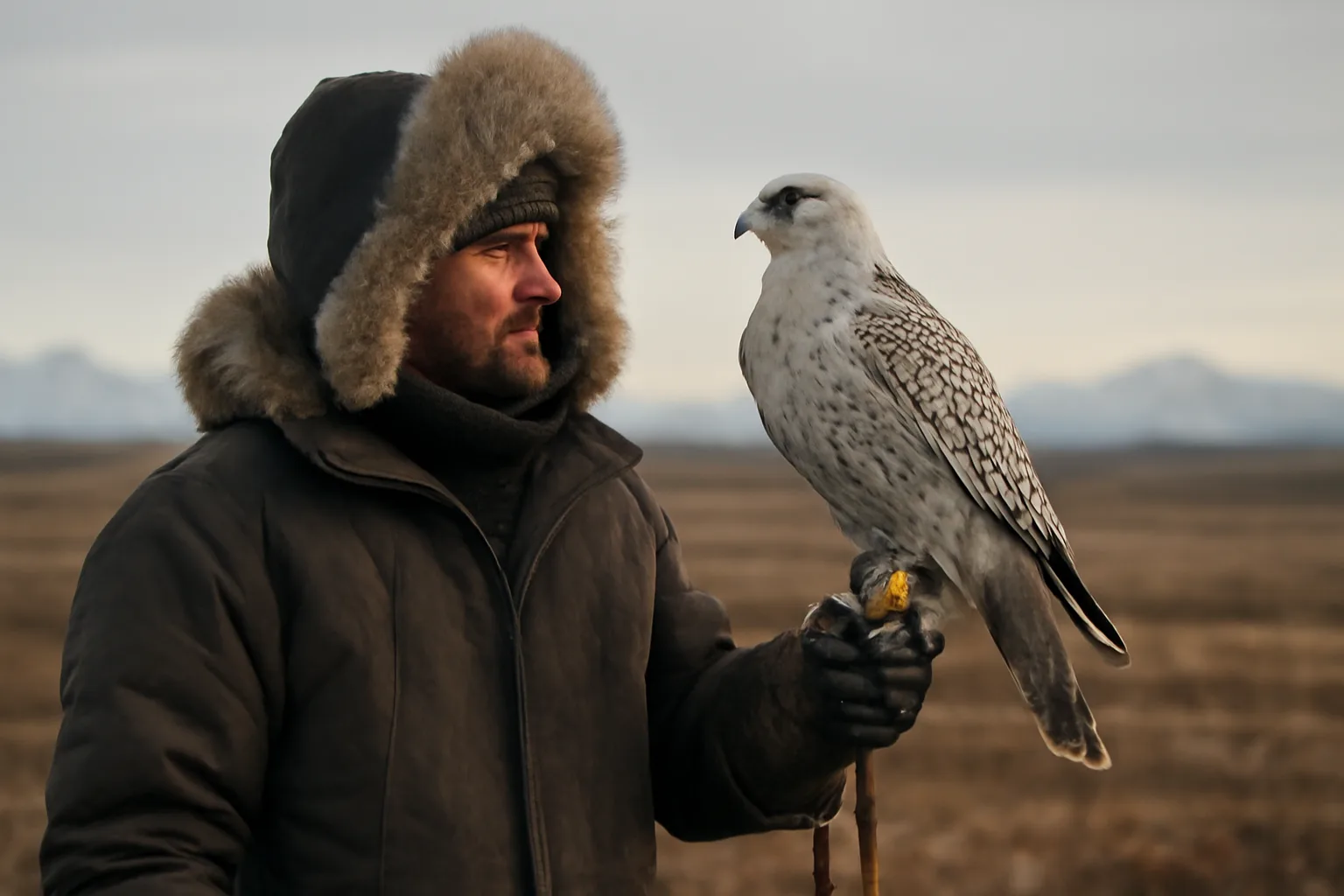
General falconers can hold up to three raptors and get a much wider species list, including gyrfalcons, which are native to Alaska and carry real cultural and practical weight in the state.
Master falconers get five birds and can keep up to three more captive-bred raptors for propagation. The path from Apprentice to Master runs a minimum of seven years of licensed practice, assuming no gaps.
How long does the falconry licensing process take in Alaska?
Three months on the fast end. A year or more if you're starting cold with no ties to the falconry community.
The steps run in sequence: pass the 100-question written exam with at least 80 percent, find a licensed General or Master sponsor who agrees to take you on, build or acquire a proper mews and weathering area, pass a facilities inspection by ADF&G, and then submit your license application [2]. Each step can stall.
The exam isn't the bottleneck. With the right study materials, most candidates pass in four to eight weeks of focused prep. The sponsor search is the real variable. Alaska has a small but active falconry community, and sponsors aren't spread evenly across the state. In Anchorage or Fairbanks you've got a fighting chance of finding someone within a couple months. In a rural area, you may be writing letters for a long time.
Facilities inspection adds another scheduling lag. ADF&G officers carry other duties, and getting an appointment can take weeks. Build your mews before you contact the agency, not after.
Once ADF&G issues your state license, USFWS activates the federal registration, usually within a few days through the electronic system. Then you're legal to get your first bird.
Budget six months as a planning horizon. That's not pessimism. That's what the community generally reports.
What does a falconry sponsor do in Alaska, and how do you find one?
Your sponsor runs your falconry education during the apprenticeship. That means teaching you how to trap, handle, hood, man, train, and hunt a raptor. It also means being available for the two-year apprenticeship window, which is a lot more than signing a piece of paper [1][2].
Federal regulations require your sponsor to hold a General or Master license and to have held that level for at least two years. They have to be willing to be named on your permit application. If your sponsor moves, loses their license, or ends the arrangement, you must notify ADF&G and either find a new sponsor or pause your apprenticeship.
Here's how to find one. Start with the Alaska Falconers Association. Get to a meet or a field event if you can. Falconers are generally open to serious candidates who show up in person and ask good questions. A cold email that says "will you be my sponsor" almost never works. A conversation at a field event, where you've already passed the exam and built your mews, has a much better shot.
Be honest with a prospective sponsor about your schedule, your location, and what you want to hunt. Alaska is big. A sponsor in the Matanuska Valley can't easily check on your bird if you're in Kodiak.
What facilities do you need to pass Alaska's mews inspection?
Federal standards set the floor, and Alaska enforces them [1][8]. Your housing has to meet these minimums before ADF&G will issue your license.
For an Apprentice holding one kestrel or red-tail, the indoor space (mews) must be at least 2.5 feet by 3 feet by 3 feet for a kestrel, and at least 4 feet by 4 feet by 6 feet for a red-tailed hawk [8]. The structure has to be secure against predators, weather, and escape. Perches must suit the species. The bird needs access to clean water for bathing.
The outdoor weathering area has to be fenced, covered, and protected from dogs and other predators. Minimum footprint matches the mews. It needs shade and shelter from wind.
All of this has to be built and working before your inspection. An inspector will not approve a permit contingent on future construction. Show up ready.
Alaska's weather adds practical concerns beyond the legal minimums. A mews that technically passes but has no insulation is going to create bird management problems in January. Build for Alaska's winters, not for the federal minimum.
How much does falconry cost in Alaska?
Nobody publishes one authoritative number, because startup costs depend heavily on what you already own and what you build versus buy. Here's an honest breakdown of the major categories.
State license fees: ADF&G charges for the falconry license. Fee schedules change, so confirm the current amount directly with ADF&G [2]. Alaska's falconry license has historically fallen in the range typical for specialty wildlife permits, but check with the agency before you budget.
Federal registration: The USFWS federal falconry registration is free as of the most recent published guidance [1].
Exam preparation: Some candidates buy commercial study kits. Others piece together materials from the North American Falconers Association and state resources. FalconryPath offers a state exam prep package at $149 that covers exam content plus the sponsor and mews checklist. Free materials exist too. Your results depend on your study discipline, not the price you paid.
Equipment: This is where costs vary most. Gear for a first bird (a hood, jesses, swivel, leash, perch, scale, and lure) runs roughly $200 to $600 depending on whether you buy new, buy used, or make some items yourself [3].
Mews construction: Building from scratch in Alaska can cost $500 to $3,000 depending on materials, whether you're converting an existing shed, and local lumber prices. Pre-built structures sit at the low end. Fully insulated purpose-built mews sit at the high end.
Bird acquisition: Trapping a wild passage bird (red-tail or kestrel) costs essentially nothing beyond your time and trapping gear (a few dollars to $50 for a bal-chatri or similar trap). Captive-bred birds from licensed breeders cost $400 to $1,500 or more depending on species and source [3].
Realistic first-year budget: $1,000 to $5,000, with wide variance. Most of that is one-time, not recurring.
See the chart below for where costs tend to land.
What raptors can Alaska falconers fly, and is the gyrfalcon actually accessible?
Alaska is one of the few states where the gyrfalcon is a realistic, legal option for licensed falconers rather than a fantasy [2][4].
Apprentices are limited to American kestrel or red-tailed hawk, period. That's federal, not a state choice.
General and Master falconers in Alaska may fly species on the state's approved list, which includes red-tailed hawks, Harris's hawks (captive-bred only, not native), peregrine falcons, prairie falcons, and gyrfalcons [2][4]. Gyrfalcons are native to Alaska's arctic and subarctic regions. USFWS sets annual take quotas for wild gyrfalcons, and Alaska's allocation shifts year to year based on population surveys. In recent years the national wild take allocation has been modest, typically in the low dozens across the whole country [4]. Getting a wild-caught gyr means checking current quota availability with ADF&G and USFWS before trapping season.
Captive-bred gyrfalcons are available from licensed propagators year-round and aren't subject to take quotas, though they cost far more than a wild-caught passage bird.
Peregrine falcons in Alaska are not a beginner bird. They need speed, space, and a falconer with enough experience to handle a high-drive long-wing. If a General falconer is eyeing a peregrine, the community expectation is that you've put in real time with your red-tail first.
How do you actually apply for a falconry license in Alaska?
The application goes to ADF&G's Division of Wildlife Conservation [2]. The practical sequence:
1. Study and pass the written exam. ADF&G or your sponsor can point you to the current exam process. The exam has 100 questions, and 80 correct answers (80 percent) is the passing threshold [1][2].
2. Secure a sponsor. Get a signed commitment, not a verbal one. The sponsor's license number goes on your application.
3. Build your facilities and schedule the inspection. Contact your regional ADF&G office to arrange it.
4. Submit your state application with the inspection sign-off and sponsor information. Pay the applicable fee.
5. Once the state license is issued, register with USFWS through the electronic system that links your state and federal credentials [1].
6. Get your bird. Wild-trapped passage birds can be taken during the legal trapping season once your permits are in hand. Captive-bred birds come from licensed breeders with a sales receipt and transfer documentation.
Don't acquire a bird before step six. Possession without a valid permit is a federal violation under the Migratory Bird Treaty Act, with penalties up to $15,000 per violation [5].
If you want a structured checklist for the prep phase, the how to start falconry in Alaska guide on this site walks the sequence in more detail.
What are Alaska's falconry hunting seasons and regulations?
Alaska sets falconry hunting seasons for game like grouse, ptarmigan, waterfowl, and hares. These are separate from the raptor-holding permits and fall under Alaska's general hunting framework [2][6].
For upland birds like ptarmigan and grouse, Alaska's falconry seasons usually run longer than firearms seasons, which is one real advantage of the sport in the state. Ptarmigan are legal quarry under Alaska regulation, and they suit gyrfalcons and peregrines well. Waterfowl falconry in Alaska requires a valid state hunting license, the federal duck stamp, and compliance with federal migratory bird hunting regulations, all on top of the falconry permits [6].
Season dates, bag limits, and zone restrictions change every year. Check the current Alaska Hunting Regulations booklet from ADF&G before you take any game [2].
Alaska has some of the most expansive legal hunting terrain in North America. Much of the state is federal land where hunting is legal with proper licensing. Confirm access rules for specific parcels with the managing agency, whether that's BLM, the Forest Service, or a national wildlife refuge.
How does Alaska compare to other states for getting into falconry?
Alaska is neither the easiest nor the hardest state to get licensed in. The exam and facilities requirements match the federal floor everywhere else. What sets Alaska apart is the sponsor availability problem and the construction challenge.
The falconry community here is small next to states like Colorado, California, or Texas (see falconry license in Arizona for a southwestern comparison). Fewer falconers means fewer potential sponsors, and in a state this spread out, finding one within driving distance isn't guaranteed.
Once you're licensed, though, Alaska's legal hunting terrain and species options are hard to match. The gyrfalcon access alone pulls in experienced falconers who relocate or travel to trap passage gyrs during quota years.
On fees, Alaska is roughly comparable to other states that charge for specialty wildlife permits. A few states have no state-level falconry fee at all. Most charge something in the $25 to $100 per year range for the license itself, though you should confirm Alaska's current schedule directly with ADF&G [2].
For a contrasting look at how different states structure requirements, the falconry license in California article covers a state with a large community and a well-documented fee structure.
What are the annual reporting and record-keeping requirements for Alaska falconers?
Federal regulations require every licensed falconer to submit an annual report to their state agency [1]. In Alaska, that report goes to ADF&G and covers the birds you held during the year, any acquisitions or disposals, mortalities, lost birds, and hunting activity. The report is due by January 31 for the preceding calendar year [1][2].
Record-keeping runs all year. You must keep acquisition documents for every raptor you hold. For wild-trapped birds, that's the trapping report. For captive-bred birds, that's the purchase receipt and transfer documentation from a licensed propagator. These records must be available for inspection by ADF&G or USFWS officers at any time [1].
Banding: wild-trapped raptors must carry a USFWS band, issued through the trapping permit process [1]. Captive-bred birds must carry both a USFWS band and a closed band from the propagator. Do not remove, alter, or transfer bands. That's a federal violation.
If a bird escapes or dies, you must report it to ADF&G promptly. "Promptly" in the regulations means within a specified number of days, so check current Alaska rules for the exact window [2]. Failing to report is a common reason falconers hit permit trouble at renewal.
Where can you get help preparing for Alaska's falconry exam?
The federal falconry exam pulls from a known set of topics: raptor biology, behavior, trapping, equipment, disease recognition, federal and state law, and field care [1]. ADF&G or USFWS can point you to study materials, and the North American Falconers Association publishes resources tied to the federal content [7].
FalconryPath's exam prep kit is built around the 100-question format with state-specific overlays for regulations that vary by state, including Alaska. At $149, it's one structured option. Whether you use that or piece together free materials from NAFA and government sources, the exam is passable with focused study. Most people who fail underestimated the regulation section, not the bird biology.
Beyond the exam, the best prep is time around birds. If a falconer near you will let you watch a training session or a hunt before you've committed, take that chance. The exam tells you whether you know the rules. Watching a real session tells you whether this is something you actually want to do.
For a full step-by-step companion to this licensing article, the how to start falconry in Alaska guide covers the sponsor search, community contacts, and first-bird decisions in more detail.
Frequently asked questions
Do you need a license for falconry in Alaska?
Yes. You need two: a state falconry license from the Alaska Department of Fish and Game and a federal falconry registration from USFWS. Both must be active before you legally possess any raptor for falconry. The state license application comes first, and the federal registration links to it through the electronic permit system. Practicing falconry without both is a federal violation under the Migratory Bird Treaty Act.
How much does falconry cost in Alaska?
First-year costs realistically run $1,000 to $5,000. The biggest variables are mews construction (roughly $500 to $3,000 in Alaska depending on materials and climate-proofing), equipment ($200 to $600), and bird acquisition ($0 for a wild-trapped passage bird up to $1,500 for a captive-bred raptor). The federal registration is free. State license fees should be confirmed with ADF&G because they change. Ongoing annual costs are much lower once the infrastructure is built.
How long does falconry take in Alaska?
From starting to study for the exam to holding your first bird: budget six months as a realistic minimum, and a year is common. Exam prep takes four to eight weeks for most people. Finding a sponsor is the real bottleneck in Alaska, where the falconry community is small and spread out. Facilities inspection adds scheduling lag. The federal registration processes quickly once the state license is issued.
What exam score do you need to pass Alaska's falconry test?
The exam has 100 questions and requires a minimum score of 80 percent, meaning 80 correct answers. This is the federal standard applied uniformly across states. The test covers raptor biology, behavior, equipment, trapping methods, federal and state law, and field care. It's not trivial. The regulation section catches most people who fail, so study it at least as hard as the biology section.
Can you fly a gyrfalcon in Alaska as a falconer?
General and Master licensed falconers in Alaska can legally possess and fly gyrfalcons. Wild take is subject to annual USFWS quota limits, which vary by year and are often small. Captive-bred gyrfalcons from licensed propagators are available year-round without quota restrictions but cost significantly more. Apprentices cannot hold gyrfalcons. They're limited to American kestrel or red-tailed hawk under federal rules.
How do you find a falconry sponsor in Alaska?
Start with the Alaska Falconers Association and attend a field event or meet in person. Sponsors must hold a General or Master license for at least two years. A cold email rarely works. A conversation at a field event, after you've already passed the exam and built your facilities, works much better. Be realistic about your location. Alaska is enormous, and a sponsor can't effectively mentor someone they can't physically visit.
What birds can an apprentice falconer use in Alaska?
Apprentices in Alaska, as everywhere in the US, are limited to American kestrel or red-tailed hawk. That restriction is federal and can't be overridden by the state. Both are legal to trap wild during permitted trapping season or to acquire captive-bred. Most Alaska apprentices choose the red-tailed hawk for its prey size and hardiness in cold weather, though both are viable first birds.
Does Alaska have a falconry age requirement?
Yes. The minimum age for an Apprentice license is 16 years old. The minimum age for a General or Master license is 18. These are federal minimums that Alaska follows. Applicants under 18 must have a parent or guardian co-sign the application in most states. Confirm Alaska's specific requirement with ADF&G, because state paperwork rules for minors can vary.
How many raptors can a Master falconer hold in Alaska?
A Master falconer in Alaska can hold up to five raptors for falconry, plus up to three additional captive-bred raptors if they hold a raptor propagation permit. General falconers are limited to three. Apprentices are limited to one. These are federal limits. Some birds, like golden eagles, require additional permits beyond the standard falconry license regardless of your level.
What hunting license do Alaska falconers need to take game?
A falconry permit covers possession and use of the raptor, but hunting game in Alaska requires a valid Alaska hunting license on top of the falconry permits. Taking waterfowl also requires the federal duck stamp and compliance with federal migratory bird hunting regulations. Upland bird and small game seasons each have their own rules. Check the current Alaska Hunting Regulations booklet from ADF&G each year.
Do Alaska falconers have to file annual reports?
Yes. Federal regulations require an annual report covering birds held, acquisitions, disposals, mortalities, escaped birds, and hunting activity. In Alaska, this goes to ADF&G and is due by January 31 for the preceding calendar year. Missing the deadline or filing an incomplete report can create problems at license renewal. Keep your acquisition records and band documentation organized all year so the report is straightforward.
Can a non-resident get a falconry license in Alaska?
Falconry licensing in Alaska ties to state residency for the state permit. Non-residents who want to hunt with raptors in Alaska should check ADF&G's non-resident rules for both the hunting license and the falconry license. Non-resident falconers licensed in another state and visiting for a hunt need to follow Alaska's rules for short-term raptor transport and hunting. Confirm current non-resident requirements directly with ADF&G.
What happens if your raptor dies or escapes in Alaska?
You must report it to ADF&G promptly. Federal regulations specify a reporting window, so check Alaska's current rules for the exact number of days. For a death, you must also document and retain the USFWS band or surrender it per agency instructions. You can't replace the bird until the loss is properly reported. Failing to report a loss is a common cause of permit complications at renewal time.
Sources
- U.S. Fish and Wildlife Service, 50 CFR 21.29 - Falconry Standards and Falconry Permitting: Federal falconry regulations: three license levels, species restrictions for apprentices (kestrel or red-tailed hawk), annual reporting requirement by January 31, banding requirements, and 80-percent passing score on the 100-question exam.
- Alaska Department of Fish and Game: Alaska state falconry license requirements, exam administration, facilities inspection process, species list including gyrfalcon, and hunting season rules for Alaska falconers.
- North American Falconers Association, Getting Started in Falconry: General equipment cost ranges and captive-bred bird price ranges cited by the primary North American falconry organization.
- U.S. Fish and Wildlife Service, Migratory Bird Program: USFWS sets annual wild gyrfalcon take quotas; Alaska's allocation varies by year based on population surveys; federal falconry registration is issued at no charge.
- U.S. Fish and Wildlife Service, Migratory Bird Treaty Act - 16 U.S.C. 703-712: Possession of a migratory bird without a valid federal permit violates the Migratory Bird Treaty Act, with civil penalties up to $15,000 per violation.
- Alaska Department of Fish and Game, Hunting Regulations: Alaska falconry hunting seasons for ptarmigan, grouse, and waterfowl; waterfowl falconry requires a state hunting license and federal duck stamp in addition to falconry permits.
- North American Falconers Association, Education Resources: NAFA publishes study materials relevant to the federal falconry exam content covering raptor biology, law, and field care.
- U.S. Fish and Wildlife Service, 50 CFR 21.29 - Facilities Standards for Falconry: Federal minimum mews dimensions: kestrel requires at least 2.5 x 3 x 3 feet; red-tailed hawk requires at least 4 x 4 x 6 feet; structures must be secure against predators and escape.