Last updated 2026-08-17
TL;DR
Alabama falconry runs through two agencies: the Alabama Division of Wildlife and Freshwater Fisheries, which issues the state license, and the U.S. Fish and Wildlife Service, which issues the federal permit. You need both before you fly a bird. Apprentice licenses require passing a 100-question written exam and finding a licensed sponsor. Budget one to three months for paperwork and at least two years at the Apprentice level.
What board or agency oversees falconry in Alabama?
Two agencies regulate falconry in Alabama, and you have to satisfy both before you can legally fly a bird.
The state agency is the Alabama Division of Wildlife and Freshwater Fisheries (ADWFF), which sits inside the Alabama Department of Conservation and Natural Resources. They issue the Alabama falconry license, inspect your facilities, and enforce state falconry regulations under Alabama Administrative Code Chapter 220-2-.92 [1].
The federal agency is the U.S. Fish and Wildlife Service (USFWS). Raptors are protected under the Migratory Bird Treaty Act of 1918, so every falconer in the country also needs a federal falconry permit issued through the USFWS Migratory Bird Permit Program [2]. Alabama runs under the cooperative state-federal framework that USFWS finalized in the 2008 rulemaking, which moved most day-to-day licensing work to the states [6].
You apply to Alabama first. Once the state approves you, you apply to USFWS for the federal permit. Neither agency is a "falconry board" the way some states run a dedicated falconry commission. Alabama's oversight runs through the standard wildlife division.
Do you need a license for falconry in Alabama?
Yes, you need two: a state falconry license from ADWFF and a federal falconry permit from USFWS. There is no legal path to possess or fly a raptor for falconry without both [2][3].
The three license classes are Apprentice, General, and Master. Apprentice is where everyone starts. You hold an Apprentice license for a maximum of two years, and during that time you practice under the direct supervision of a licensed General or Master falconer who agrees to sponsor you [3].
The written exam for the Apprentice level covers raptor biology, care, equipment, and regulations. Alabama's exam is 100 questions, and you need 80% or higher to pass [3]. Contact ADWFF directly for current exam scheduling, since the state controls the test format and administration.
After at least two years as an Apprentice and after demonstrating competence, you apply for a General license. General falconers wait an additional five years before applying for Master status. Years with a lapsed or absent license generally don't count toward the minimums [3].
How much does falconry cost in Alabama?
Costs fall into three buckets: government fees, equipment, and the bird itself. Government fees are the smallest part by far.
The Alabama license fee and the federal permit fee are both modest, but confirm current amounts with ADWFF and USFWS. Agency fee schedules change, and no article can guarantee a figure that stays accurate. Historically, state falconry license fees in southeastern states have run in the $25 to $50 range annually, and the federal permit has landed in the $25 to $100 range depending on the fee tier [7]. Confirm before you budget.
Equipment is where the real money goes. Federal regulations set minimum standards for raptor housing (the mews) and equipment, and your inspection has to meet them [3]. A compliant mews for an Apprentice bird (a kestrel or red-tailed hawk) runs $300 to $800 in materials if you do the work yourself, or $1,500 and up if you contract it. Basic falconry equipment (hood, jesses, bells, leash, perch, scale, telemetry transmitter and receiver) runs $400 to $900 for gear that lasts.
The bird itself, for an Apprentice, must be a wild-trapped American kestrel or red-tailed hawk taken under your state and federal permits [3]. A wild-trapped bird has no purchase price, but trapping takes equipment and often a mentor's help. Health checks and early veterinary care add $100 to $300 in the first year.
Add it up. First-year costs realistically land between $1,000 and $3,000 for most Alabama Apprentices, and the spread comes almost entirely from whether you build your own mews and how much vet care the bird needs.
| Cost category | Low estimate | High estimate |
|---|---|---|
| State license fee (annual) | $25 | $50 |
| Federal permit fee | $25 | $100 |
| Mews construction | $300 | $1,500+ |
| Basic equipment (hood, jesses, telemetry, etc.) | $400 | $900 |
| Veterinary care, year one | $100 | $300 |
| First-year total (approx.) | $850 | $2,850+ |
These are estimates. Confirm government fees with ADWFF and USFWS before you budget. [1][2]
How long does falconry take in Alabama?
Plan for three to six months from your decision to start until you're legally flying a bird, and at least two years before you can move beyond Apprentice.
The paperwork phase takes time on its own. You study for and pass the written exam, submit your state application, have your facilities inspected by an ADWFF officer, receive your state license, then file your federal permit application with USFWS. USFWS permit processing has historically taken four to twelve weeks, though that swings with staff workload [7]. Nobody can guarantee a processing timeline.
Finding a sponsor is usually the longest variable. The North American Falconers Association keeps a member directory, and many Alabama falconers are in it, but no licensed falconer is obligated to take on an apprentice [4]. Some people find a sponsor in a few weeks through a local club. Others spend months looking. The Alabama Falconers Association is the in-state club most likely to connect you with a willing sponsor.
After you're licensed and sponsored, the two-year Apprentice period is a minimum, not an average. Plenty of apprentices take longer because they're still learning. The two years start from the date your first federal permit is issued [3].
Here's how I'd sequence it: start studying now, hunt for a sponsor at the same time, build your facilities before you apply for inspection, and don't order equipment until you've passed the exam.
What are the Apprentice falconer requirements in Alabama?
Alabama follows the federal minimum requirements for Apprentice falconers, plus any extra state conditions ADWFF sets. Here's what the federal framework requires, which Alabama has adopted [3]:
You must be at least 14 years old. If you're under 18, a parent or guardian co-signs the application.
You must pass the written examination with a score of at least 80% [3].
You must have a sponsor who holds a current General or Master falconry license in good standing. That sponsor must have held a General or higher license for at least two years. The sponsor supervises your practice and attests to your readiness to advance.
Your facilities must pass inspection before you receive the license. The minimum mews standards live in 50 CFR 21.29, which specifies dimensions, perch types, weathering area requirements, and security features to prevent raptor escape [3]. An ADWFF officer runs the inspection.
As an Apprentice, you're limited to one bird at a time. The species is limited to American kestrel or red-tailed hawk, both wild-trapped [3]. You can't fly a bird acquired from a breeder or transferred from another falconer at this level.
The two-year clock doesn't start when you pass the exam or get the state license. It starts when your federal permit is issued.
How do you find a falconry sponsor in Alabama?
This is the step that actually slows most people down, and there's no shortcut.
Start with the Alabama Falconers Association. It's the primary in-state club, and members are used to prospective apprentices reaching out. Showing up to a meet or a field event beats a cold email every time.
The North American Falconers Association keeps a member directory [4]. Search for Alabama members and reach out directly. Be specific about where you live. A sponsor three hours away can't supervise you in any practical way.
Falconry Facebook groups and regional forums have active Alabama contingents. The culture here is generally welcoming to serious beginners, but "serious" carries weight. Show up knowing the regulations, having studied raptor care, with your facilities plan ready. A sponsor takes on real responsibility for your training. They won't commit to someone who hasn't done the homework.
Some apprentices spend six months or more finding a willing sponsor. Budget for that delay.
What facilities does Alabama require for a raptor mews?
Federal regulations in 50 CFR 21.29 set the floor for mews construction, and Alabama inspections check against those standards [3]. The key requirements for an Apprentice-level mews (single bird, kestrel or red-tailed hawk):
The mews must be large enough for the bird to move freely and extend its wings without striking walls or perches. For a red-tailed hawk, that means a minimum interior footprint of roughly 8 by 8 feet with a ceiling of at least 6 feet. Building larger is always better. Check the current regulatory text directly, since agency dimensions can be updated.
The structure must be secure against predator entry and bird escape. That means solid walls or heavy-gauge wire, a secure door with a double-safety latch, and no gaps larger than an inch.
You need a separate weathering area, an outdoor space where the bird sits in fresh air and sunlight, and it also has to be predator-proof.
Perches must fit the species and not cause foot injury. Astroturf-covered perches and traditional block perches both work if they match the bird.
Build before you apply for inspection. Don't schedule the visit until the mews is fully finished. A failed inspection delays your whole timeline and forces a repeat trip.
What birds can an Alabama Apprentice falconer fly?
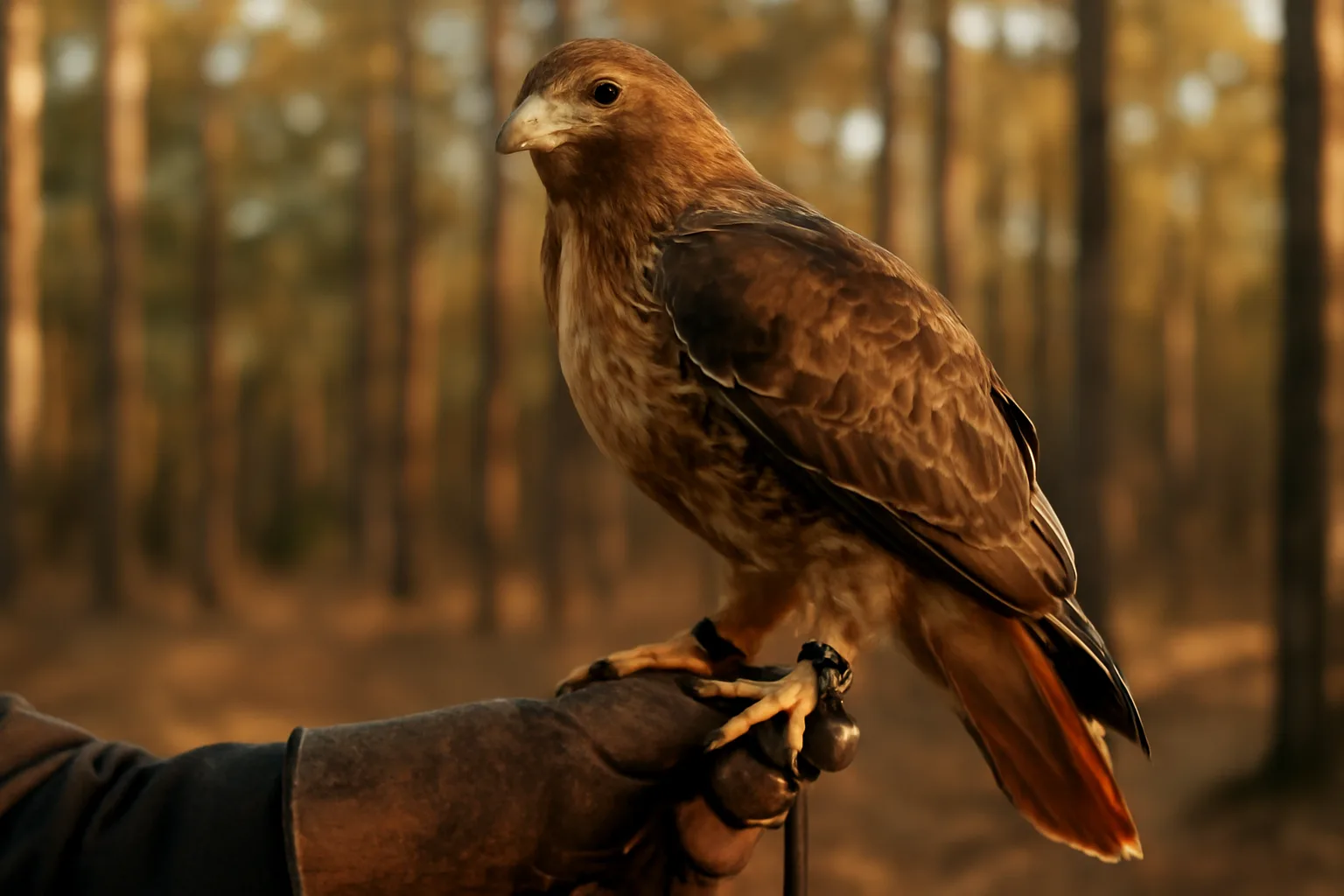
Federal law limits Apprentice falconers to two species: the American kestrel and the red-tailed hawk [3]. Both must be wild-trapped under your state and federal permits. You can't receive a captive-bred bird or a transferred bird as your first Apprentice bird.
Most Alabama apprentices start with a red-tailed hawk. They're abundant across the state, trap well in autumn, and forgive the early handling mistakes a new falconer makes [8]. Kestrels are smaller and demand faster reflexes. They're a solid choice if your hunting terrain and quarry fit (open fields, sparrows, starlings).
Once you advance to General, your species options widen. General falconers can possess any native raptor and certain non-native species, subject to availability and applicable permits. Masters have the widest latitude, including eagles under specific conditions [3].
Comparing Alabama to its neighbors? Georgia and Arkansas run the same federal framework with the same Apprentice restrictions. See falconry board in Georgia and falconry board in Arkansas for side-by-side context.
How does the Alabama falconry inspection process work?
After you pass the written exam and submit your state application, an ADWFF wildlife officer inspects your falconry facilities before your license is issued. It's more than a formality.
The officer checks that your mews meets federal and state construction standards, that your equipment list is complete (at minimum: jesses, leash, swivel, and a way to weigh the bird), and that you understand basic care. Some inspectors ask questions too. Treat it as an informal oral component of the exam.
Schedule the inspection through the ADWFF regional office covering your county. Wait times vary by region and season. Autumn, which is trapping season, tends to be busiest, so applying in late summer helps.
Once the state inspection passes, ADWFF issues the state license. You then file your federal permit application with USFWS. Do not trap or possess a bird until both the state license and the federal permit are in hand.
How does Alabama falconry compare to neighboring states?
Alabama, Georgia, Arkansas, and Florida all run under the same federal framework, so the big requirements match: two species for Apprentices, a two-year minimum, a required sponsor, and a mews inspection. The differences show up in fees, exam administration, and how active the state clubs are.
Georgia's Wildlife Resources Division handles their program much like Alabama; falconry board in Georgia has the detail. Florida runs through the Florida Fish and Wildlife Conservation Commission and has historically kept more active permitting infrastructure; see falconry board in Florida.
Arkansas runs a lean program with a smaller active falconry population, which can make sponsor-finding harder; falconry board in Arkansas covers that.
Moving to Alabama with an active falconry license from another state? Federal regulations allow interstate reciprocity in some cases, but you still notify ADWFF and may need a new state license. Confirm the transfer process with ADWFF before you move your bird.
For a wider regional comparison, the falconry board in Arizona and falconry board in Colorado articles show how western states handle the same federal rules with different state-level requirements.
Where to start your Alabama falconry application
The sequence: study, find a sponsor, build your facilities, pass the exam, submit your state application, pass inspection, get the state license, submit the federal application, get the federal permit, then trap your bird.
For the study phase, the federal regulations in 50 CFR 21.29 are public on the Electronic Code of Federal Regulations [3]. ADWFF has the state-specific requirements and exam information [1]. The North American Falconers Association's education materials are a good supplement [4].
Want a structured path through exam prep and the paperwork sequence? FalconryPath's Apprentice kit at /start covers written exam prep, the sponsor search strategy, and a mews checklist built around the federal inspection standards. Everything you need is also in the primary sources above. The kit just organizes it.
The one thing nobody can shortcut is the sponsor relationship. Start building that connection before you've finished a single form.
What are the hunting rules for Alabama falconers?
Falconry is a legal method of take in Alabama for certain game species, but you still need a valid Alabama hunting license on top of your falconry license [1]. Bag limits, seasons, and legal quarry come from ADWFF, and you follow them the same way a gun hunter does.
Alabama has seasons for squirrel, rabbit, and various upland birds that are legal quarry for falconry. Waterfowl seasons are set jointly by ADWFF and USFWS under the Migratory Bird Treaty Act framework, and waterfowl falconry carries its own rules on zone and season compliance [2].
Falconry on public land in Alabama is generally allowed where hunting is allowed, but some Wildlife Management Areas add specific restrictions. Check current WMA regulations through ADWFF before you fly on public land.
Posted private land needs the landowner's permission, same as any other hunting method. Most Alabama falconers build relationships with farmers who like the pest-control side of hunting rabbits and squirrels.
As you move to General and Master, the species you can hunt may widen, but quarry is always limited to species with open legal seasons. You can't use a raptor to take a species with no open season or one that's otherwise protected.
Frequently asked questions
Do you need a license for falconry in Alabama?
Yes, you need two licenses: a state falconry license from the Alabama Division of Wildlife and Freshwater Fisheries and a federal falconry permit from the U.S. Fish and Wildlife Service. You must have both before you can legally possess or fly a raptor. The state license requires passing a 100-question written exam with a score of at least 80% and having your facilities inspected.
How much does falconry cost in Alabama?
Government fees are modest (historically $25 to $100 per agency, but confirm current amounts with ADWFF and USFWS). The bigger costs are equipment and the mews: plan $400 to $900 for basic gear and $300 to $1,500 for mews construction depending on whether you build it yourself. First-year total typically runs $850 to $2,850 for most Apprentice falconers. Wild-trapped Apprentice birds have no purchase price.
How long does falconry take in Alabama?
From starting your application to flying your first bird, budget three to six months for exam, facilities inspection, state license, and federal permit processing. Finding a sponsor can add months. The Apprentice license has a two-year minimum, which starts from the date your federal permit is issued. Advancing to General requires at least two full years at Apprentice level; Master requires five more years at General.
What is the minimum age to get a falconry license in Alabama?
Federal regulations set the minimum age at 14 years old. Applicants under 18 need a parent or legal guardian to co-sign the application. Alabama follows this federal minimum. There's no maximum age.
What species can an Alabama Apprentice falconer trap and fly?
Apprentice falconers in Alabama are limited to two species: the American kestrel and the red-tailed hawk. Both must be wild-trapped under the authority of your state and federal permits. You cannot receive a captive-bred or transferred bird at the Apprentice level. Most Alabama apprentices start with a red-tailed hawk because they're abundant and tolerant of beginner handling.
Do I need a hunting license in addition to my falconry license in Alabama?
Yes. A falconry license authorizes you to possess and fly a raptor, but it doesn't cover the take of game. You need a valid Alabama hunting license to hunt with your bird, and you must comply with all applicable seasons and bag limits set by the Alabama Division of Wildlife and Freshwater Fisheries.
How do I find a falconry sponsor in Alabama?
Start with the Alabama Falconers Association and the North American Falconers Association member directory. Attending club events and field meets is the most effective approach. Be prepared to show you've studied the regulations and have a facilities plan ready. Sponsors take on real supervisory responsibility, so demonstrating commitment before asking matters. Finding a sponsor can take anywhere from a few weeks to six months or more.
What are the mews requirements for Alabama falconry?
Federal regulations in 50 CFR 21.29 set minimum mews standards, and Alabama inspections check against them. For a single Apprentice bird, you need a secure structure large enough for the bird to extend its wings, predator-proof construction, a secure latch, and a separate weathering area. An ADWFF officer inspects before your license is issued. Build to completion before scheduling the inspection.
How does the Alabama falconry exam work?
The Alabama Apprentice exam has 100 questions covering raptor biology, care, equipment, and state and federal regulations. You need a score of 80% or higher to pass. Contact ADWFF directly for current exam scheduling, fees, and format since the state controls administration and can update it. Study from 50 CFR 21.29, the state regulations, and NAFA's materials.
Can I transfer my falconry license to Alabama from another state?
Federal regulations allow some interstate reciprocity, but you must still notify the Alabama Division of Wildlife and Freshwater Fisheries and you may need a new state license. The process depends on your current license class and how Alabama handles reciprocity at the time of transfer. Confirm the specific transfer process with ADWFF before you move or move your bird.
How long does federal falconry permit processing take?
USFWS federal permit processing has historically taken four to twelve weeks, but this varies with staff workload and application volume. Nobody can guarantee a specific timeline. Apply for the federal permit only after your Alabama state license is issued. Don't trap or possess a bird until both the state license and federal permit are in hand.
What agency in Alabama handles falconry complaints or violations?
The Alabama Division of Wildlife and Freshwater Fisheries handles state-level enforcement. USFWS Special Agents handle federal violations under the Migratory Bird Treaty Act. Serious violations (possessing a raptor without a permit, selling protected birds) can result in federal charges under 16 U.S.C. 703-712, which carries substantial penalties.
Is there an Alabama falconry club I can join?
Yes. The Alabama Falconers Association is the primary in-state club and the best starting point for connecting with sponsors, attending field events, and getting practical guidance from experienced falconers. The North American Falconers Association is the national organization; membership gives you access to their directory and annual field meets.
Sources
- Alabama Department of Conservation and Natural Resources, Outdoor Alabama (state hunting and falconry licensing): Alabama state falconry license issued by ADWFF; state exam and facility inspection required; state regulations under Alabama Administrative Code Chapter 220-2-.92
- U.S. Fish and Wildlife Service, Migratory Bird Program: Federal falconry permit required for all falconers under Migratory Bird Treaty Act; USFWS administers federal migratory bird permits
- U.S. Electronic Code of Federal Regulations, 50 CFR 21.29: Falconry Standards and State, Tribal, and Territory Permit Requirements: Federal Apprentice species limited to kestrel and red-tailed hawk; two-year Apprentice minimum; mews construction standards; 80% exam pass score; sponsor requirements; General license requires 5 additional years for Master
- North American Falconers Association: NAFA maintains a member directory useful for finding sponsors; national falconry education resources available to members
- U.S. Fish and Wildlife Service, Migratory Bird Treaty Act of 1918: Raptors are protected under the Migratory Bird Treaty Act, requiring federal permits for falconry possession
- Federal Register Vol. 73, No. 130 (July 8, 2008): Revisions to Falconry Regulations (73 FR 39788): 2008 USFWS rulemaking shifted primary falconry licensing administration to states under cooperative state-federal framework
- U.S. Fish and Wildlife Service, Migratory Bird Permits (permit types and application information): Federal falconry permit application process and fee information administered by USFWS
- Cornell Lab of Ornithology, All About Birds: Red-tailed Hawk (Buteo jamaicensis): Red-tailed hawks are abundant across Alabama and suitable for Apprentice falconers; species range and behavior